
The Complete Guide to Hair Types: From Straight to Coily
Why Your Hair Type Matters More Than You Think
You’ve probably bought a shampoo or styling product that promised amazing results. The reviews were glowing. The bottle looked great in your shower. And then it did absolutely nothing for your hair. Or worse, it made your hair greasy, flat, frizzy, or crunchy. For a focused guide on how these types play out for guys, see our breakdown of men’s hair types.
You’ve probably also tried a hairstyle that looked incredible on someone else and fell completely flat on you. Same cut, same styling, totally different outcome.
The reason is almost always the same: you were using products or techniques designed for a different hair type.
Your hair type affects more than you’d expect. It determines how quickly your hair gets oily, how much moisture it actually needs, which products absorb into your strands versus sitting on top doing nothing, which styles hold their shape and which collapse within an hour, and how susceptible your hair is to specific kinds of damage. Two people can use the exact same product and get opposite results. That’s not the product’s fault. It’s a mismatch.
If you are between two hair types, always follow the care routine for the more textured type. Under-moisturizing causes more damage than over-moisturizing.
The classification system most people use today comes from Andre Walker, Oprah Winfrey’s longtime hairstylist, who popularized the 1-4 typing system in the 1990s. It groups all hair into four broad categories based on curl pattern, then subdivides each with A, B, and C grades. It’s not perfect. It has real limitations (which we’ll get into). But it remains the most widely used framework in the hair care world, and it gives you a genuinely useful starting point for understanding what your hair needs.
Take photos of your hair from multiple angles on wash day. Your curl pattern can vary across different sections of your head, and most people are actually a blend of two adjacent types.
Once you know your type, you stop guessing. You stop wasting money on products that weren’t made for you. And you start working with your hair instead of fighting against it.
The Andre Walker hair typing system used worldwide was originally created for a segment on The Oprah Winfrey Show in the 1990s. It was never intended to be a scientific classification.
The Hair Typing System Explained
The upside: 1A hair is naturally shiny. Flat-lying cuticles reflect light like a mirror, giving straight hair that glossy, silky look that curlier types have to work harder to achieve.
Type 1B
Straight with slight body. This is the most common straight hair type. There’s a bit of volume and movement, especially at the ends, but no actual wave pattern. If you curl it with hot tools, those curls will hold for a few hours before gradually relaxing back to straight. Strand thickness is usually medium, which gives it more substance than 1A without the heaviness of 1C.
Most people with 1B hair find it fairly low-maintenance. It doesn’t get oily as fast as 1A, holds styles reasonably well, and doesn’t require heavy products to look good.
Type 1C
Straight with subtle bends. Not quite wavy, but not pin-straight either. 1C often has noticeable thickness and a bit of natural movement that gives it a textured, lived-in look. In humid conditions, slight waves can appear, especially around the face. It holds a curl from hot tools better than 1A or 1B.
Some people with 1C hair don’t realize they have it because they’ve been blow-drying it straight their entire lives. If you’ve ever noticed a slight bend or wave in your air-dried hair that disappears with heat styling, you might be 1C rather than 1B.
Care Essentials for Type 1
Lightweight products are the rule. Heavy conditioners, thick creams, and most oils will weigh straight hair down and make it look greasy faster.
Volumizing shampoos help create lift at the roots. Apply conditioner only from mid-length to ends, never at the roots (that’s a one-way ticket to flat, limp hair by lunchtime). Dry shampoo becomes your best friend for extending time between washes. It absorbs excess oil at the roots and adds a bit of texture.
With oils and serums, less is more. One or two drops on the ends. That’s it. What looks “dewy” on curly hair looks “unwashed” on straight hair. If you use a leave-in product, choose a spray formula over a cream.
Wavy Hair (Type 2A, 2B, 2C)
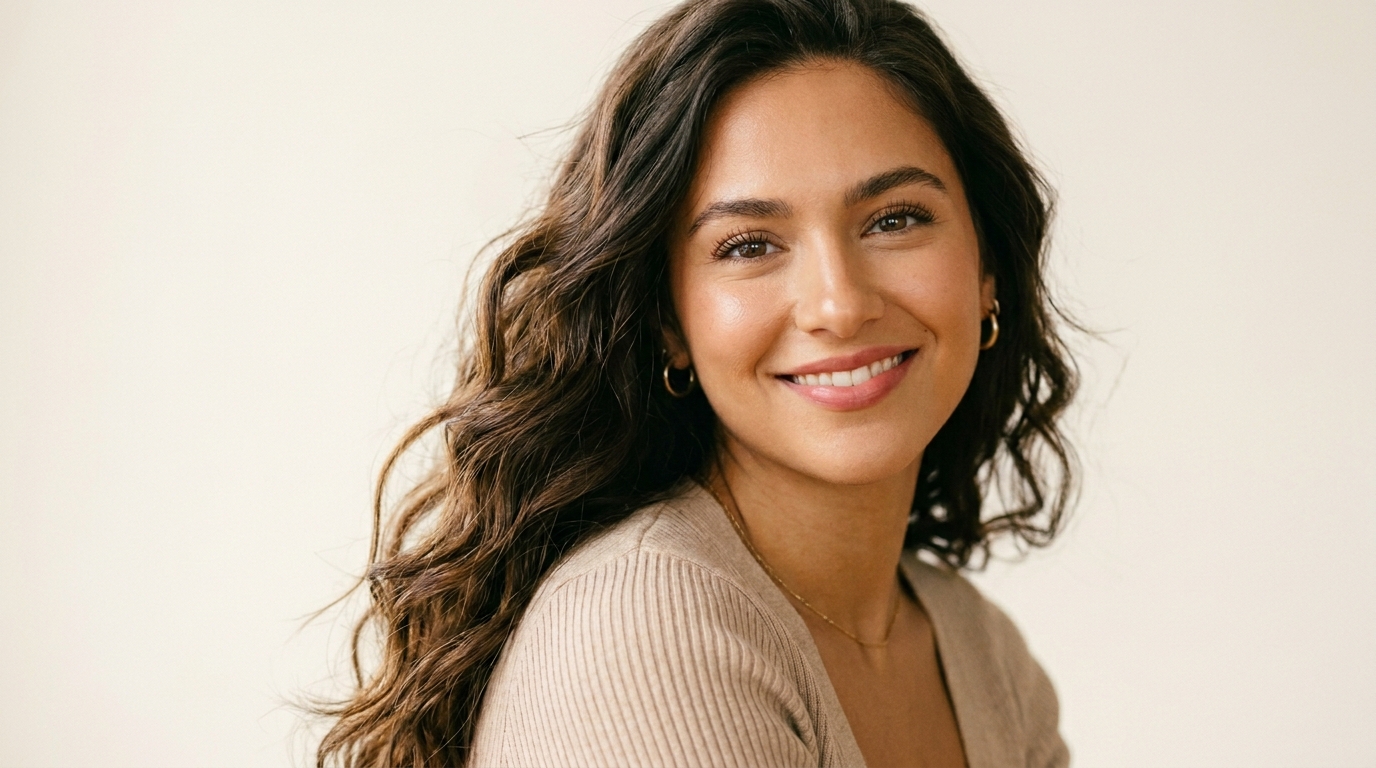
Wavy hair sits between straight and curly, and that in-between status is exactly what makes it tricky. It’s too curly for straight-hair products and too straight for curly-hair products. Many people with wavy hair spend years treating it as straight before discovering their natural texture.
Type 2A
Gentle, loose S-waves. Hair is mostly straight at the roots, with waves starting at mid-length or below. Fine texture is common. These waves are delicate and disappear easily under the weight of heavy products or even vigorous towel-drying.
The challenge with 2A: your hair can look straight one day and wavy the next depending on how it dries, the humidity level, and whether you touched it while it was drying. It’s the most unpredictable subtype. Many people with 2A hair don’t identify as having wavy hair at all because the waves come and go.
Type 2B
More defined S-waves that start closer to the roots. You’ll notice some frizz, especially at the crown, which is where humidity hits first. Strand thickness is usually medium. These waves hold their shape better than 2A but still straighten out easily with brushing or heavy product.
Here’s what’s common with 2B: many people don’t know they have wavy hair because they’ve been brushing it straight since childhood. If you’ve ever noticed that your hair has more texture and movement on days you skip the hairbrush, you’re probably seeing your natural 2B pattern emerge.
Type 2C
Deep S-waves that border on curly. Where 2B waves gently undulate, 2C waves have real depth and definition. They can look like loose curls when properly styled. Thick, coarse strands are typical. Frizz potential is significant.
2C is the highest-maintenance wavy type. It needs more moisture than 2A or 2B, tangles more easily, and responds dramatically to humidity. But it also has the most volume and visual impact of the wavy subtypes. When 2C waves are well-defined, they’re stunning.
Care Essentials for Type 2
The wavy hair paradox: you need moisture without weight. That rules out the heavy butters and thick creams that curly hair thrives on, but you still need more hydration than straight hair requires.
Use lightweight conditioners and avoid applying anything heavy near your roots. Scrunch your hair upward when applying products instead of raking downward (raking pulls waves apart). Let waves air dry whenever possible, or use a diffuser on low heat. A regular blow dryer pointed directly at your hair will blow the waves straight out.
For 2A and 2B, look for mousse or lightweight gel to define waves without weighing them down. 2C can handle slightly heavier products like light curl creams.
The “squish to condish” technique works particularly well for wavy hair: while your hair is soaking wet in the shower with conditioner in it, cup sections in your hands and squeeze upward, pushing the water and conditioner into your hair. This encourages wave formation from the start.
One universal rule for all wavy types: stop brushing your dry hair. Seriously. A brush through dry wavy hair destroys wave definition and creates frizz. If you need to detangle, do it in the shower with conditioner in your hair, using a wide-tooth comb or your fingers.
See how different hairstyles look on you — upload your photo and try any style with our AI tool.
Try HairStyleMojo Free →Curly Hair (Type 3A, 3B, 3C)
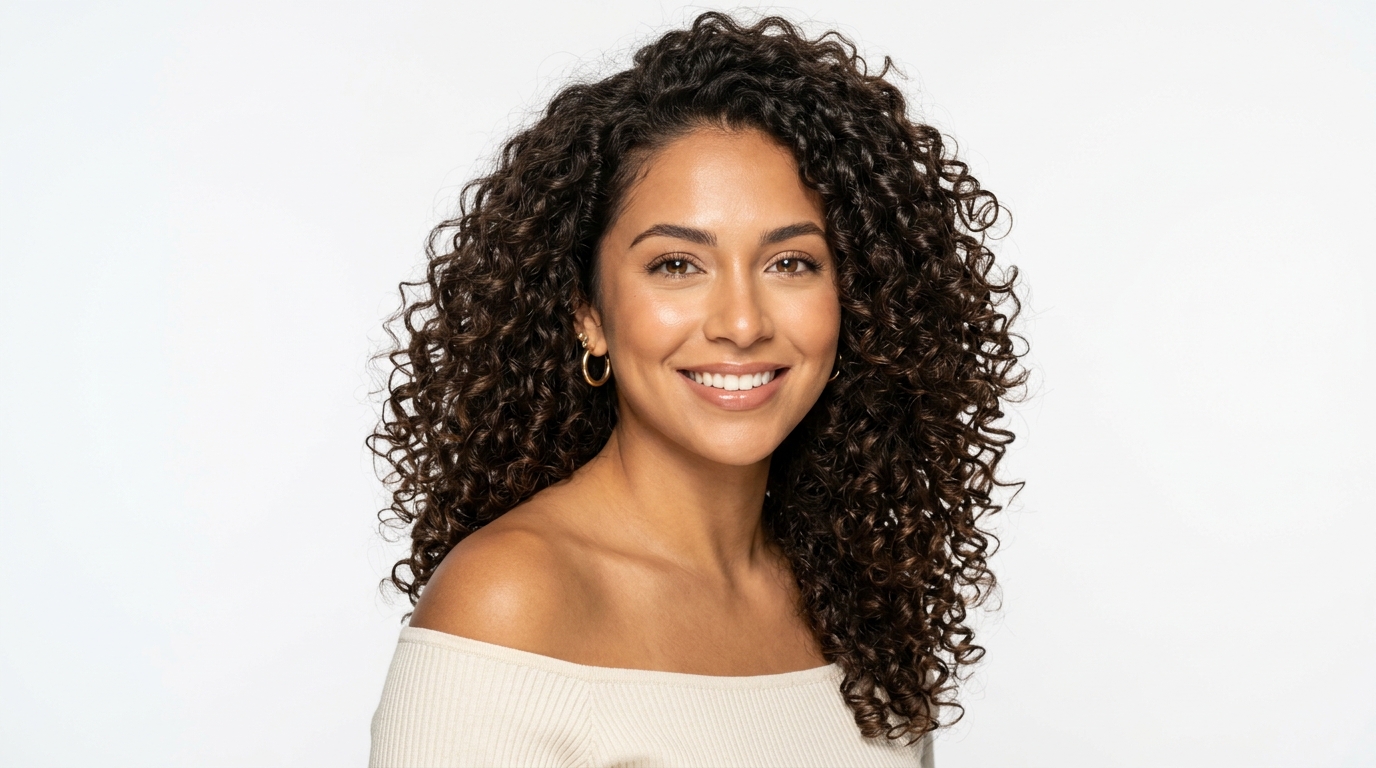
Curly hair forms actual spirals. When you pull a single strand straight and let go, it springs back into a coil. That springiness is the defining characteristic of Type 3. The curls are visible, defined, and have real bounce. They also have real demands, primarily around moisture.
Type 3A
Loose, springy S-curls about the diameter of a piece of sidewalk chalk. These are well-defined spirals with visible space between each coil, giving the hair a bouncy, voluminous look. Compared to tighter curl types, 3A hair tends to have noticeable shine because the looser curl allows more light to reflect off each strand.
Comparing your hair to Instagram photos to determine your type is misleading. Most styled hair photos involve diffusers, gels, and specific techniques that dramatically alter the natural pattern.
Texture is usually fine to medium. 3A curls can stretch easily under the weight of water, so your hair might look wavy when soaking wet and curly once it dries. These curls respond well to lightweight products and can get weighed down quickly by anything too heavy.
Type 3B
Ringlet curls roughly the diameter of a marker or finger. More volume, more density, and more friction between strands than 3A. This is where dryness starts becoming a real concern. The curve of each curl creates a longer path for sebum to travel from scalp to ends, so natural oils struggle to make the full journey. The mid-lengths and ends of 3B hair are chronically under-moisturized unless you intervene.
Shrinkage is noticeable with 3B curls. Your hair is significantly longer than it looks when curled. A strand that measures 10 inches when stretched might only appear 6 or 7 inches in its natural coiled state. This catches people off guard, especially after haircuts.
Type 3C
Tight corkscrew curls about the diameter of a pencil or drinking straw. Dense, voluminous, and full of texture. These curls pack together tightly, creating a lot of visual impact and body.
3C is prone to significant dryness. Shrinkage can make your hair appear 30-40% shorter than its actual stretched length. The tight coils create friction between strands, which means tangling is a daily reality. But when 3C curls are properly moisturized and defined, the result is a head of hair with incredible structure and dimension.
Care Essentials for Type 3
Moisture is priority number one. Every product decision, every technique, every habit should be evaluated through the lens of “does this add or remove moisture from my hair?”
Switch to a sulfate-free shampoo. Sulfates are effective cleansers, but they strip too much natural oil from hair that’s already prone to dryness. If you need a deeper clean occasionally, use a gentle clarifying shampoo once a month, but keep your regular wash sulfate-free.
Leave-in conditioner is not optional for Type 3 hair. Think of it as a daily essential, like moisturizer for your face. Apply it to soaking-wet hair after every wash and let it absorb before adding any styling products.
Detangle only when your hair is wet and coated in conditioner. Use a wide-tooth comb or just your fingers. Start from the ends and work upward toward the roots, gently working through knots without ripping through them. Never brush dry curly hair. A brush through dry Type 3 hair separates the curl clumps, creates frizz, and can cause breakage.
The “plopping” technique helps define curls without introducing frizz. After applying your products to soaking-wet hair, lay a cotton t-shirt or microfiber towel flat on a surface. Flip your hair forward onto it, then wrap the fabric around your head and secure it. Leave it for 15-30 minutes. This removes excess water gently while encouraging your curls to clump together in defined spirals.
Deep condition at least every two weeks. For 3C hair, weekly deep conditioning makes a real difference.
Coily Hair (Type 4A, 4B, 4C)
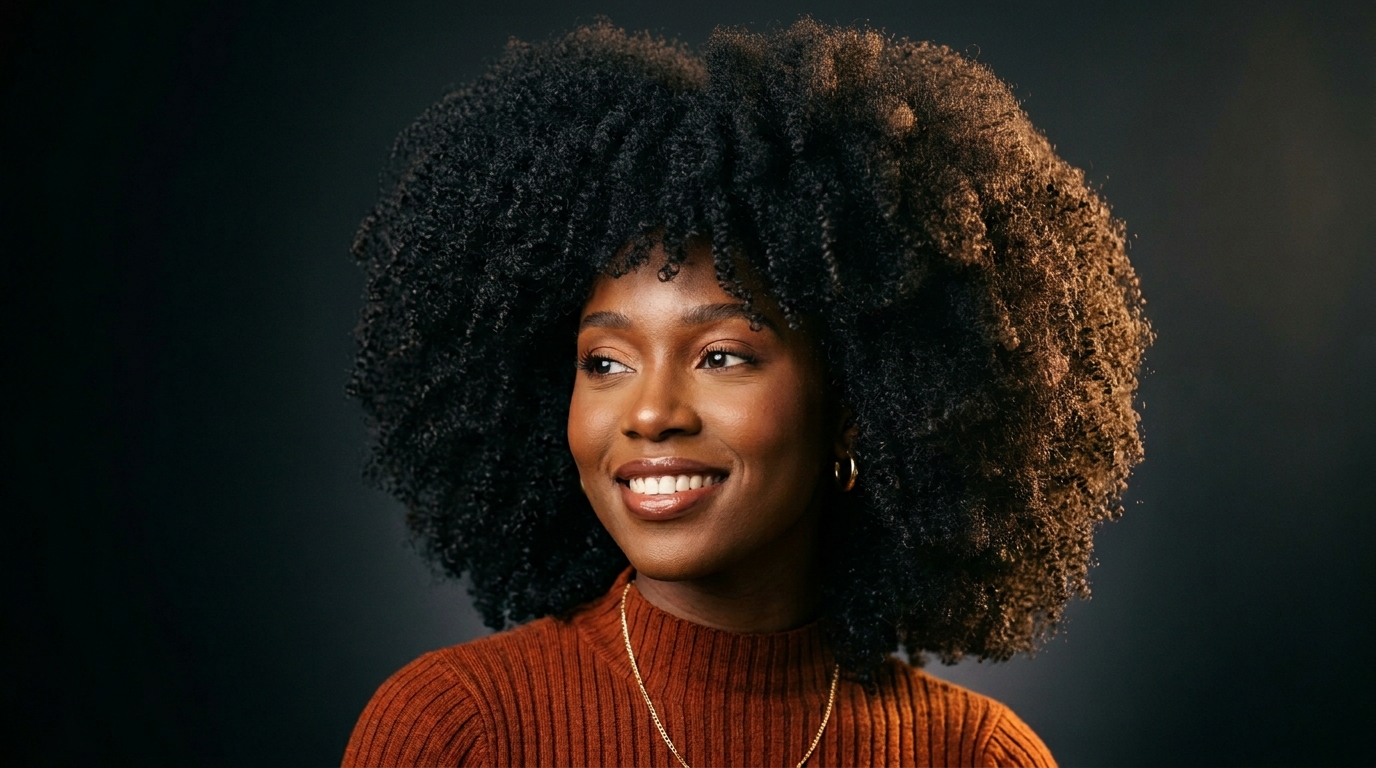
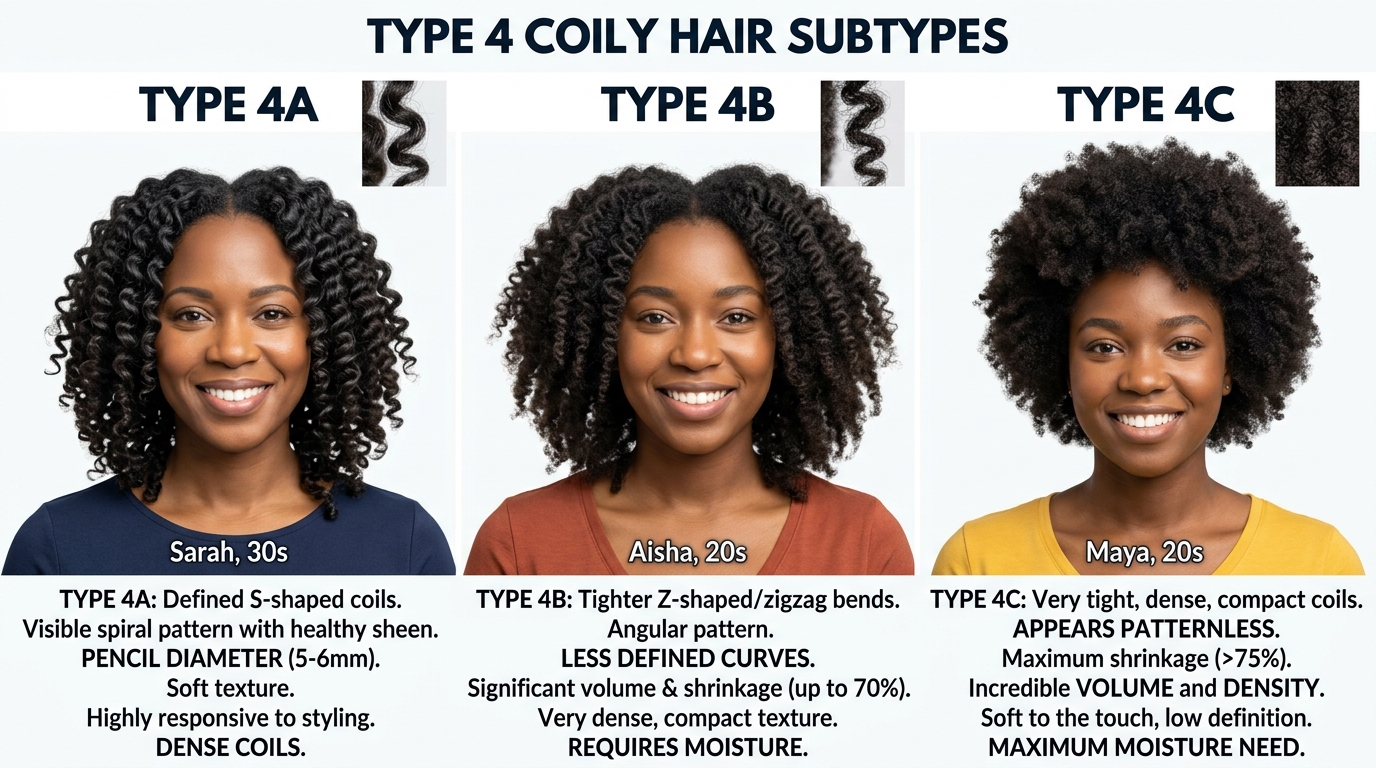
Type 4 hair is the most diverse, most versatile, and most misunderstood category in the entire system. It can be shaped into more styles than any other type. Tight coils, stretched blowouts, braids, twists, locs, bantu knots, flat twists, finger coils, wash-and-go styles, updos. The range is extraordinary.
It’s also the most fragile. Those tight bends and coils create stress points along each strand where breakage is more likely to occur. The tighter the pattern, the more stress points per inch. Understanding Type 4 hair means understanding that moisture retention is everything. Not just adding moisture, but keeping it there.
Type 4A
Defined S-shaped coils with a visible curl pattern. Each coil is roughly the diameter of a crochet needle. Among Type 4 subtypes, 4A has the most visible and defined pattern. You can see individual coils clearly.
When well-moisturized, 4A hair can appear shiny because the curl pattern, while tight, still allows some light to reflect along the curves. Shrinkage is substantial: about 60-70%. That means a 12-inch strand might appear 4 inches long when coiled in its natural state. This is one of the most misunderstood aspects of Type 4 hair. The length is there. It’s just hiding.
Type 4B
Z-shaped bends rather than round coils. Instead of curving in spirals, each strand bends at sharp angles, creating a zigzag pattern. The look is less defined than 4A, with a cotton-soft texture that feels fluffy and dense.
4B hair has very high density, meaning there are a lot of individual strands packed tightly together. Shrinkage reaches up to 75%. The styling versatility is remarkable: 4B hair can be stretched, coiled, twisted, braided, and shaped in ways that other types simply can’t achieve. But that versatility requires consistent moisture to prevent dryness and breakage.
Type 4C
The tightest coil pattern in the classification system. Individual curls are so tight that the pattern is hard to see without stretching a strand. This isn’t a lack of pattern. It’s an extremely tight one. If you gently pull a 4C strand and look closely, you’ll see tiny, densely packed coils.
4C hair has the most shrinkage of any type, often 75% or more. A strand that’s 16 inches when stretched might appear 4 inches in its natural state. This creates one of the most common misconceptions about 4C hair: that it doesn’t grow. It grows at the same rate as any other hair type (about half an inch per month). The length retention challenge is about preventing breakage, not about growth speed.
4C hair is the most fragile type because the tight bends create more stress points per inch than any other pattern. Rough handling, dry detangling, tight hairstyles, and cotton pillowcases all contribute to breakage at those stress points. Gentle, intentional care makes all the difference.
Care Essentials for Type 4
Your scalp produces sebum just like everyone else’s scalp. The same amount. But that oil physically cannot travel down hair that bends every few millimeters. On straight hair, sebum slides from scalp to ends in a day. On Type 4 hair, it barely makes it past the first centimeter. So your ends are perpetually starved of moisture unless you provide it externally.
Deep conditioning: At least once a week. Not a suggestion. A requirement. Use a thick, moisturizing deep conditioner and leave it on for 20-30 minutes, ideally with a plastic cap or warm towel to help the product penetrate.
The LOC or LCO method: This is the gold standard for Type 4 moisture. LOC stands for Liquid (water or a water-based leave-in), Oil (to help seal moisture), Cream (to lock everything in). Some people find that LCO (swapping the order of oil and cream) works better for their hair. Experiment with both. The principle is the same: add moisture, then seal it so it doesn’t evaporate.
Protective styles: Braids, twists, buns, locs, and other styles that tuck your ends away reduce daily manipulation. Every time you comb, brush, or restyle your hair, you risk breakage at those stress points. Protective styles let your hair rest and retain length. Rotate styles every 2-4 weeks to prevent tension damage.
Detangling: Only when your hair is saturated with conditioner. Never dry. Use your fingers or a wide-tooth comb, working from ends to roots in small sections. If you hit a stubborn knot, add more conditioner and work through it gently. Ripping through tangles causes breakage that accumulates over time.
Satin and silk: Sleep on a satin or silk pillowcase, or use a satin bonnet or silk scarf. Cotton pillowcases create friction that pulls moisture from your hair and causes breakage while you sleep. This single change often produces visible results within weeks.
Wash frequency: Every 7-14 days is typical for Type 4 hair. Washing too frequently strips moisture faster than you can replace it. Between washes, refresh your hair with a water-based spray and reseal with oil.
Hair Type vs. Hair Texture vs. Hair Porosity
This is where most hair guides stop too early. Your curl pattern (the 1-4 system) is only one piece of the puzzle. Two other factors are equally important: texture and porosity. Skipping these is like knowing your shoe size but ignoring the width. You’ll get a shoe that technically fits but isn’t comfortable. Our guide to hair texture explains the differences between fine, medium, and coarse strands.
Texture (Strand Thickness)
Texture refers to the thickness of individual strands, not how much hair you have overall. You can have fine strands but a lot of them (fine texture, high density) or thick strands but fewer of them (coarse texture, low density).
Fine: Individual strands are thin. If you hold one between your thumb and index finger, you can barely feel it. Fine hair is prone to breakage because each strand has a smaller diameter and less structural protein. Heavy products weigh it down fast. On the positive side, fine hair is often very soft and silky.
Medium: Average thickness. You can feel a strand between your fingers but it doesn’t feel rough or wiry. This is the most versatile texture. It responds well to most products and techniques without being easily overwhelmed.
Coarse: Individual strands are thick and strong. You can definitely feel a strand between your fingers, and it might feel slightly rough or textured. Coarse hair is more resistant to chemical processing (color, relaxers, perms take longer to work). It handles heavy products and heat better than fine hair, but it can also be harder to soften and style.
The test: Pull a single strand from your head. Roll it between your thumb and index finger. If you can barely feel it, you have fine hair. If it feels like a piece of sewing thread, you have coarse hair. Somewhere in between is medium.
Porosity (Moisture Absorption)
Porosity describes how well your hair absorbs and retains moisture. It depends on the condition of your cuticle, the outermost layer of each hair strand. Think of the cuticle as overlapping shingles on a roof. When those shingles lie flat and tight, water has a hard time getting in (low porosity). When they’re raised or damaged, water floods in easily but also escapes quickly (high porosity).
Low porosity: The cuticle is tightly packed. Water beads up on the surface of your hair instead of absorbing. Products tend to sit on top rather than sinking in. Your hair takes a long time to get fully wet and even longer to dry. Chemical treatments (color, relaxers) take longer to process. The good news: once you get moisture in, low-porosity hair holds onto it well.
Normal (medium) porosity: The cuticle allows moisture in at a healthy rate and retains it reasonably well. This is the easiest porosity level to maintain. Hair takes color well and responds predictably to most products.
High porosity: The cuticle has gaps, either from genetics or from damage caused by heat, chemical processing, or environmental exposure. High-porosity hair absorbs water extremely fast (gets soaking wet in seconds) but also loses moisture rapidly. It frizzes easily because the raised cuticle catches humidity from the air. Color fades faster than expected.
The float test: Take a clean strand of hair (freshly washed, no product) and drop it in a glass of room-temperature water. Wait about four minutes. If it still floats on the surface, you likely have low porosity. If it sinks slowly to the middle, you likely have normal porosity. If it drops to the bottom quickly, you likely have high porosity. This test isn’t laboratory-grade accurate, but it gives you a useful rough estimate.
Why All Three Matter Together
Imagine two people who both have 3B curls. Same curl pattern. But one has fine, low-porosity 3B hair and the other has coarse, high-porosity 3B hair. Their routines should look completely different.
The person with fine, low-porosity 3B hair needs lightweight products that won’t sit on top of their strands. They should apply products to very wet hair to help absorption. Heavy butters and thick creams will leave their hair looking greasy and weighed down, and their curls will lose definition.
The person with coarse, high-porosity 3B hair needs rich, thick products that fill in the gaps in their cuticle. Lightweight sprays won’t cut it. They need butters, heavy creams, and oils to seal moisture in. Without them, their hair will feel dry and straw-like within hours of washing.
Same curl type. Completely different needs. That’s why the typing system alone isn’t enough.
How to Figure Out Your Hair Type
Follow these steps to identify your natural curl pattern accurately.
Step 1: Start with a clean slate. Wash your hair with a gentle clarifying shampoo. No conditioner afterward. The goal is to remove all product buildup so your hair can show its true texture without anything influencing the pattern.
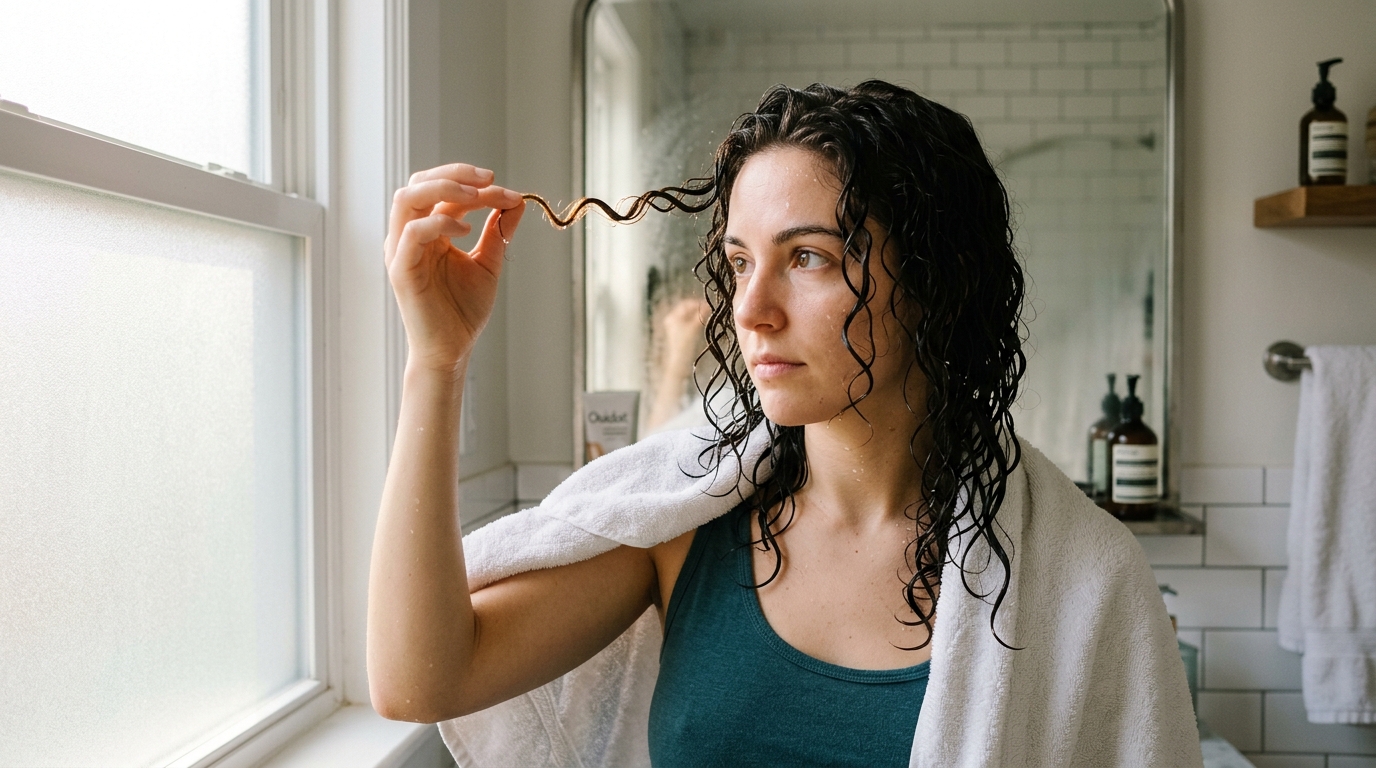
Step 2: Air dry completely. Don’t touch your hair while it dries. No towel scrunching (that disrupts the pattern), no product (that alters the pattern), no diffuser (that enhances the pattern). Let gravity and your natural texture do all the work. This takes patience. For thick or long hair, it might take several hours.
Step 3: Observe your pattern. Once your hair is 100% dry, look at it in a mirror. Compare what you see to the descriptions above. Are your strands falling straight? Do you see S-shaped waves? Defined spirals? Tight coils?
Step 4: Check multiple areas. Don’t just look at the front. Pull hair from your temples, your crown, the sides, and the nape of your neck. Examine each section separately. Most people find that they have 2-3 different subtypes across their head. The crown and nape are often different. The hairline might be a completely different pattern than the middle of your head.
Step 5: Account for heat damage. If you’ve been heat-styling regularly (flat iron, curling iron, blow dryer on high heat), your true pattern may be suppressed. Heat damage can temporarily or permanently loosen your natural curl. If you suspect this is happening, you may need a “heat detox” of 2-4 weeks with zero hot tools before your real pattern reveals itself. Some people are shocked to discover they have curls or waves they never knew existed.
Common Points of Confusion
“My hair is straight when wet but wavy when dry.” You have wavy hair. Water is heavy. It pulls waves down and stretches them out. Once the water evaporates, your natural wave pattern returns.
“My curls are different on different sides of my head.” Normal. Almost everyone has asymmetry in their curl pattern. Your dominant side (the side you sleep on, the side that gets more sun exposure, the side you tend to tuck behind your ear) may have a slightly different pattern due to environmental factors and mechanical wear.
“My hair type changed after pregnancy.” This happens. Hormonal shifts during pregnancy, postpartum, puberty, and menopause can genuinely alter your curl pattern. Some people gain curls. Some lose them. Some find their texture gets coarser or finer. If your hair doesn’t behave the way it used to, hormones are the most likely explanation. Certain medications (particularly hormonal ones) can have the same effect.
Your hair type can change over your lifetime. Hormonal shifts during pregnancy, menopause, and even extended stress can permanently alter your curl pattern and hair density.
“I’m not sure if I’m 2C or 3A.” Subtypes along the boundaries blur together. If you’re between two types, you probably have characteristics of both, and that’s fine. Pick the one that matches most of your hair most of the time, and use it as your baseline. You don’t need to be exactly one type. The system is a guide, not a diagnosis.
What to Do Once You Know Your Type
Knowing your type is the starting line, not the finish. Here’s the first step for each category.
Type 1 (Straight): Focus on volume and oil management. Lightweight shampoos, minimal conditioner at the roots, and dry shampoo for extending time between washes. Avoid heavy products. Your hair reflects light beautifully on its own, so your goal is to keep it clean, bouncy, and not weighed down.
Type 2 (Wavy): Learn to scrunch and ditch the brush on dry hair. Your waves have probably been hiding under years of brushing and blow-drying. Give them a chance to show up by scrunching product into wet hair and letting it air dry or diffusing on low heat. You might be surprised by how much texture you actually have.
Type 3 (Curly): Invest in a good leave-in conditioner and learn to detangle gently. These two changes alone can transform curly hair. Moisture and gentle handling are the foundation everything else builds on. If your curls look frizzy and undefined, the answer is almost always more moisture and less manipulation.
Type 4 (Coily): Moisture, moisture, moisture. Protective styles. Satin pillowcases. And patience with shrinkage. Your hair isn’t short. It’s coiled so tightly that the length hides. Learn the LOC or LCO method, commit to weekly deep conditioning, and handle your hair like the delicate, beautiful fiber it is.
For every type: Use your hair type as a starting point, then refine based on your texture and porosity. A 3A with fine, low-porosity hair lives in a different world than a 3A with coarse, high-porosity hair. The type gets you in the right neighborhood. Texture and porosity get you to the right house.
Now that you know your hair type, find hairstyles that actually work with it instead of against it. Upload your own photo and try different looks instantly with [HairStyleMojo’s virtual try-on tool](https://hairstylemojo.com).
—
Key Takeaways
- The hair typing system runs from 1 (straight) to 4 (coily), with subtypes A, B, and C from loosest to tightest. Andre Walker created this framework in the 1990s, and it remains the most widely used system for classifying hair.
- Your curl pattern is one of three factors. Texture (strand thickness) and porosity (how your hair absorbs moisture) are equally important in determining what products and techniques will work for you.
- Type 1-2 hair tends toward oily because sebum travels down easily. Type 3-4 tends toward dry because curls and coils slow sebum’s path. This is why straight hair needs lightweight products and curly/coily hair needs rich, moisturizing ones.
- Most people have more than one hair type across their head. Your crown, temples, nape, and sides can all be different subtypes. That’s completely normal.
- Knowing your type stops you from wasting money on products designed for different hair. A product that works miracles on 4C coils will flatten 2A waves. A volumizing spray made for 1B hair will do nothing for 3C curls.
- Hair type can change with hormones, aging, medication, and chemical processing. If your hair suddenly behaves differently, reassess your type rather than forcing your old routine.
- The best routine is one built for your specific combination of type, texture, and porosity. The typing system gives you direction. Testing and adjusting gives you results.
—
Frequently Asked Questions
Yes. Hormonal shifts during puberty, pregnancy, postpartum recovery, and menopause can genuinely alter your curl pattern. Some women develop curls during pregnancy that stay permanently. Others find their curls loosen with age. Certain medications, particularly hormonal ones like birth control or thyroid medication, can also change your hair’s behavior. Chemical processing (relaxers, perms, keratin treatments) can temporarily or permanently alter your natural pattern. If your hair isn’t acting the way it used to, reassessing your type is a smart first step.
Type 2A-2B (gentle to moderate waves) is very common among people of European descent. Type 4B-4C (tight coils and z-pattern bends) is prevalent among people of African descent. Looking at the global population as a whole, wavy hair is likely the most common category, but reliable worldwide data is limited. Hair type distribution varies enormously by geographic ancestry, and most studies have focused on specific populations rather than global averages.
It’s useful, but it’s incomplete. The 1-4 system classifies hair based on curl pattern alone. It doesn’t account for strand thickness (fine vs. coarse), density (how many strands you have), porosity (how hair absorbs moisture), or elasticity (how far hair stretches before breaking). All of those factors significantly affect how your hair behaves and what it needs. Think of the typing system as a starting point that gets you in the right ballpark. Then use texture and porosity assessments to dial in your specific routine.
This is subjective, and every type has its own challenges. Type 1A gets oily by dinnertime. Type 2 can’t decide if it’s straight or wavy. Type 3 needs constant moisture. That said, Type 4C requires the most intentional moisture management and the gentlest handling of any type. The tight coils create fragility that demands careful detangling, consistent deep conditioning, protective styling, and satin everything. It’s not harder in the sense of being worse. It just requires more deliberate, informed care.
It influences your options, but it doesn’t limit them. Most hairstyles can work on most hair types with the right technique, products, and sometimes tools. A person with Type 1 hair can get beautiful curls with a curling iron. A person with Type 4C hair can achieve a sleek straight look with a blowout. The difference is in the method and maintenance required.
This is exactly why virtual try-on tools are valuable. Instead of guessing whether a style will suit your face and hair, you can see it on your own photo before committing to anything at the salon.
—
Sources and References
- De la Mettrie, R. et al. (2007). Shape variability and classification of human hair: a worldwide approach. Human Biology, 79(3), 265-281.
- Loussouarn, G. et al. (2007). Worldwide diversity of hair curliness: a new method of assessment. International Journal of Dermatology, 46(s1), 2-6.
- Franbourg, A. et al. (2003). Current research on ethnic hair. Journal of the American Academy of Dermatology, 48(6), S115-S119.
- Robbins, C.R. (2012). Chemical and Physical Behavior of Human Hair (5th ed.). Springer.
- Walker, A. (1997). Andre Talks Hair. Simon & Schuster.
- Gavazzoni Dias, M.F. (2015). Hair cosmetics: an overview. International Journal of Trichology, 7(1), 2-15.
- American Academy of Dermatology. Tips for Healthy Hair Care. aad.org
Try different hairstyles on yourself
Upload your photo and see how any hairstyle looks on you before committing.
Try HairStyleMojo Free