
Hair Type Chart: The Complete Visual Guide from 1A to 4C
The hair type chart splits all hair into four categories (straight, wavy, curly, coily) and three subcategories each (A, B, C), giving you 12 possible types. Once you know yours, product recommendations and care routines start making sense.
This guide covers all 12 types with descriptions specific enough to actually identify yours.
How to Read the Hair Type Chart
The system is simpler than it looks.
The number (1 through 4) tells you the overall curl pattern:
- 1 = Straight
- 2 = Wavy
- 3 = Curly
- 4 = Coily
The letter (A through C) tells you how pronounced that pattern is:
- A = Loosest version of that type
- B = Middle ground
- C = Most intense version of that type
So 2A is the loosest wave, 4C is the tightest coil. That’s it. The whole chart is built on those two axes.
This system was created by celebrity hairstylist Andre Walker in the 1990s. It’s not scientific law. It’s a useful shorthand that works well enough to guide real decisions about products and care.
Do not assume your hair type determines which products you need. A person with fine 3B curls needs completely different products than someone with coarse 3B curls, even though the curl pattern is identical.
Type 1: Straight Hair
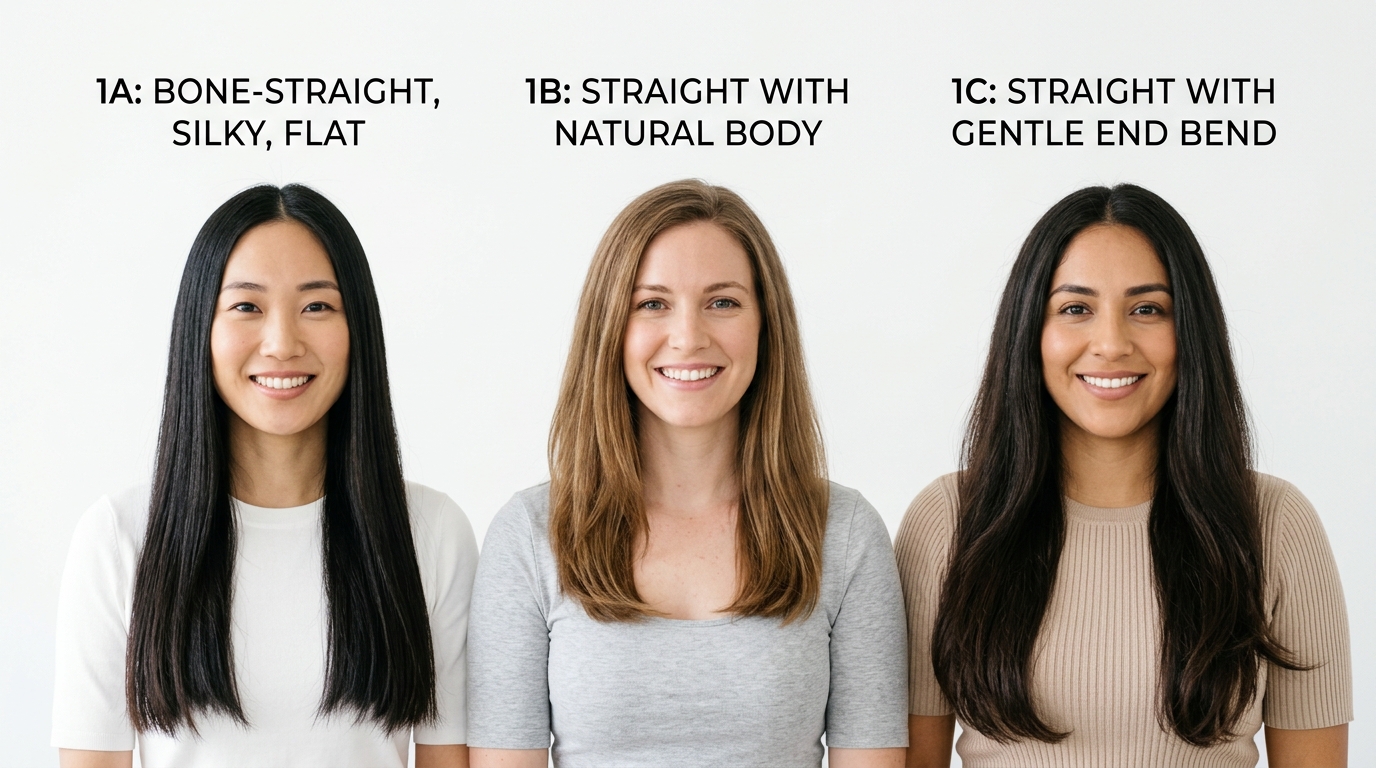
Straight hair lies flat from root to tip with no curl or wave pattern. It reflects the most light (which is why it tends to look shiny) and distributes oil the fastest.
1A: Pin Straight
The straightest hair that exists. Individual strands are fine and soft, with zero bend or body. 1A hair resists curling irons because there’s no natural texture to build on. It gets oily faster than any other type because sebum slides straight down the shaft with nothing to slow it.
Type 1A hair is the rarest hair type worldwide, considered one of the rarer hair types. It is so straight that it physically cannot hold a curl from a curling iron for more than a few hours.
Common concern: Flat, limp roots by end of day.
1B: Straight With a Slight Bend
The most common straight subtype. 1B hair is mostly straight but has a subtle bend near the ends, giving it slightly more body than 1A. Strands are medium thickness. It holds a curl better than 1A (though still not great) and doesn’t look quite as flat against the head.
Common concern: Frizzy ends without enough perceived volume at the roots.
1C: Straight With Body
Straight hair that has some natural thickness and movement without forming actual waves. 1C strands are coarser than 1A or 1B and can hold a blowout or curling iron style reasonably well. Some people with 1C hair see a slight wave after air drying, but it doesn’t form a true S-pattern.
Common concern: Can feel coarse or stiff, especially in dry climates.
Type 2: Wavy Hair
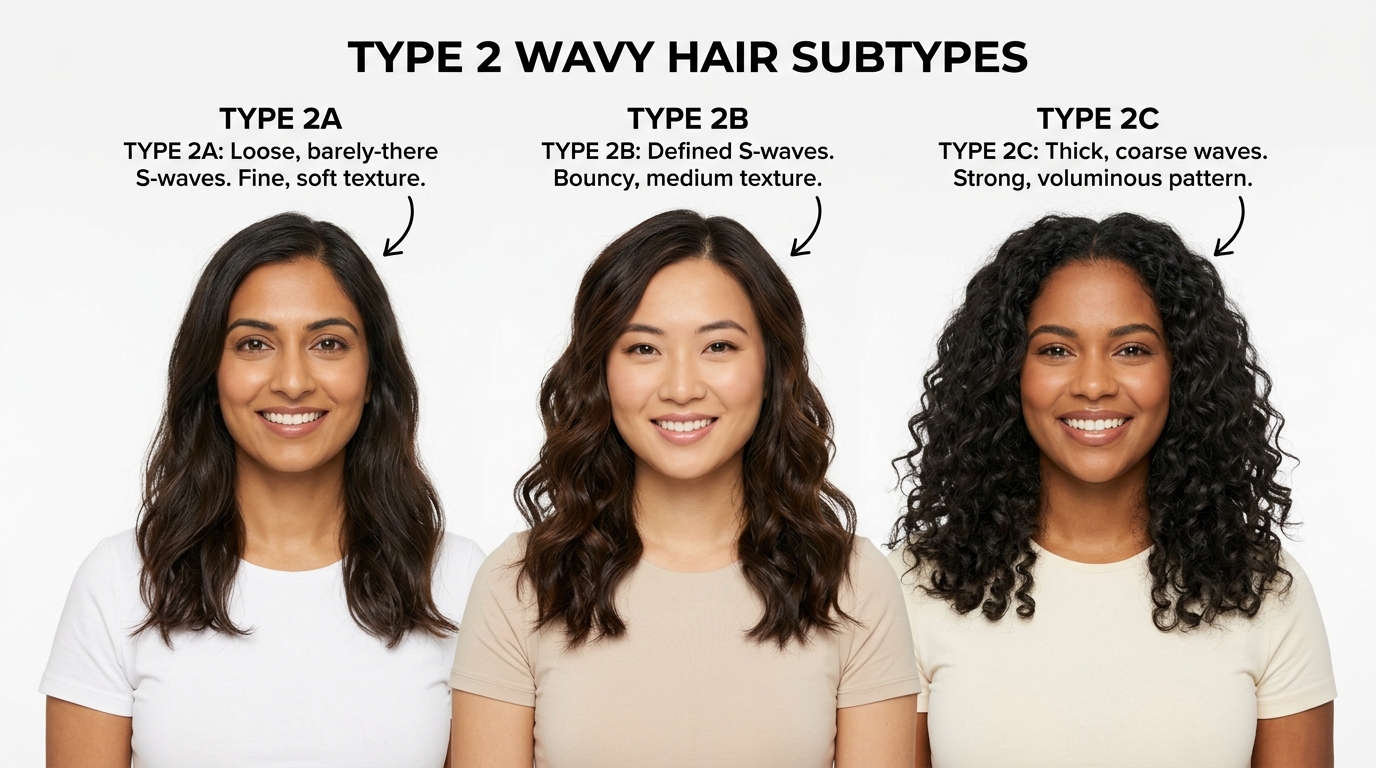
Wavy hair forms S-shaped waves and sits between straight and curly. Too heavy a product flattens the wave; too light a product lets frizz take over.
2A: Loose S-Waves
Fine, thin waves that mostly show up from mid-length down. The root area lies flat. 2A hair looks almost straight when wet and reveals its wave only after air drying. Heavy creams, butters, or oils will weigh it down and kill the wave entirely.
Common concern: Waves disappear by midday or after sleeping on them.
2B: Defined S-Waves
2B hair forms clear S-shapes starting from mid-length, with more volume and body than 2A. Frizz becomes a real factor, especially in humidity.
Common concern: Frizz around the crown and inconsistent wave pattern (wavy in some sections, straighter in others).
If your hair seems to match different types in different sections, that is completely normal. Most people have 2-3 curl patterns on their head. Treat each zone according to its type.
2C: Deep Waves Bordering on Curls
The “is it wavy or curly?” type. 2C waves are thick, well-defined, and start closer to the root. Some waves spiral into actual curls. The hair is coarser and denser than 2A or 2B. Many people with 2C hair spend years thinking they have “frizzy straight hair” before realizing they have waves that need moisture, not smoothing.
Common concern: Frizz that resists most anti-frizz products; inconsistency between wash days.
Print out a hair type chart and check your hair against it on wash day when your hair is fully dry with zero product. That is the only reliable way to type your hair accurately.
See how different hairstyles look on you — upload your photo and try any style with our AI tool.
Try HairStyleMojo Free →Type 3: Curly Hair
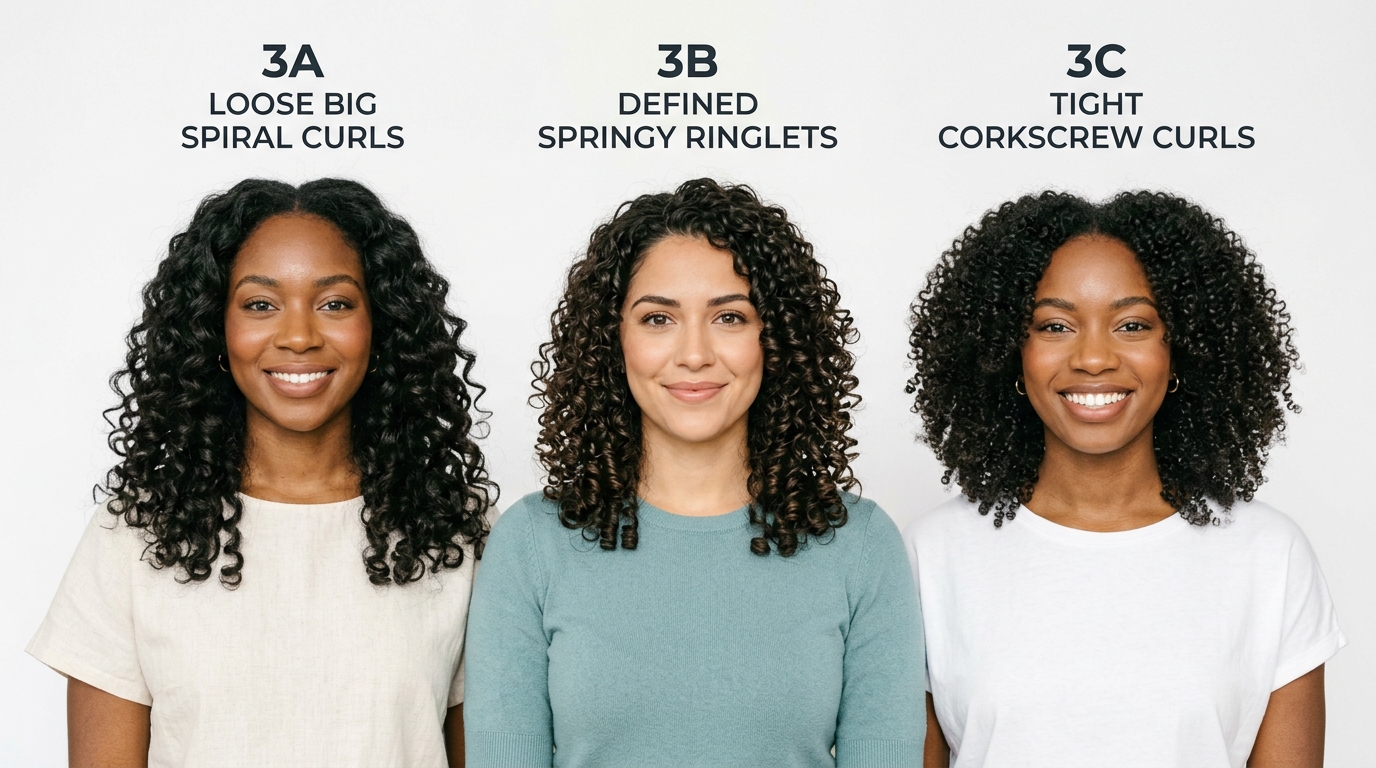
Curly hair forms definite spirals or ringlets. It’s drier than straight or wavy hair because the twists in each strand prevent sebum from traveling the full length. Moisture is the central challenge for all Type 3 hair.
3A: Loose Springy Curls
Big, bouncy curls roughly the diameter of sidewalk chalk. 3A curls have a defined S-pattern, plenty of shine, and the least frizz of the curly types. They elongate when pulled and spring back when released. Lightweight products work best here.
Hair diameter and curl pattern are controlled by different genes. You can have fine hair with tight coils or coarse hair that is bone-straight. Texture and type are independent.
Common concern: Curls losing definition over the course of a day; lack of volume at the root.
3B: Tighter Ringlet Curls
Tighter spirals about the diameter of a Sharpie marker. 3B hair has significantly more volume than 3A and is more prone to dryness. The curls are springy, dense, and can vary in tightness across the head. Shrinkage becomes a real factor here: hair can appear several inches shorter than its stretched length.
Common concern: Dryness, tangles, and the time investment required for wash day.
3C: Tight Corkscrew Curls
The tightest curls in the curly category. 3C curls are roughly pencil-diameter, densely packed, with significant volume. Shrinkage hits 30% to 40%. Each strand twists tightly enough that individual curls are distinct and separate. Without consistent moisture, 3C hair becomes dry and brittle fast.
Common concern: Significant shrinkage that masks true length; dryness that requires consistent deep conditioning.
Type 4: Coily Hair
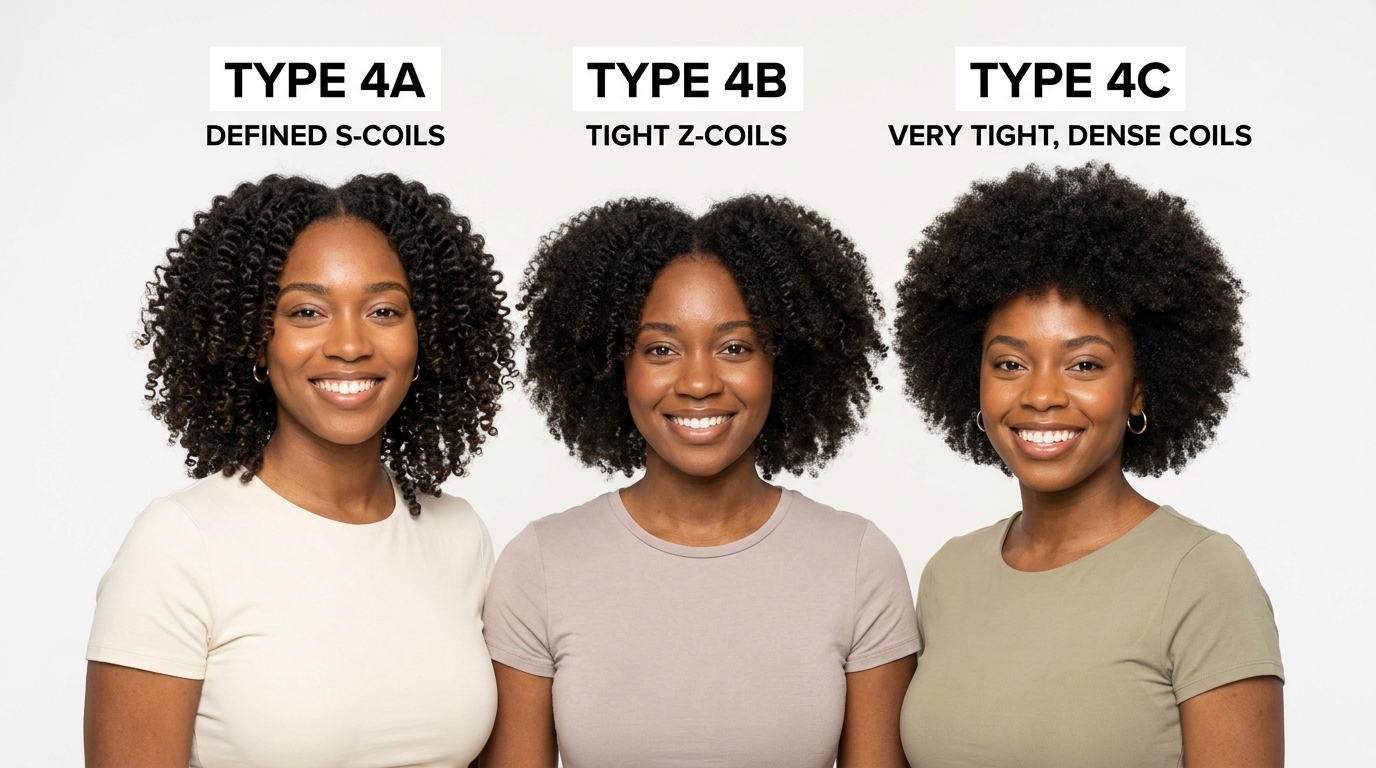
Coily hair has the tightest patterns, the most shrinkage, and the greatest moisture needs. It’s structurally the most fragile type, but also the most versatile for styling. Type 4 hair can be shaped, stretched, twisted, and braided in ways no other type can.
4A: Defined Coils
4A hair forms visible, springy coils roughly the diameter of a crochet needle. The S-pattern is clearly defined and coils spring back when stretched. Shrinkage hits up to 70%. It retains more moisture than 4B or 4C due to the slightly looser pattern.
Common concern: Shrinkage masking length; tangles when coils interlock with each other.
Focus on the mid-shaft of your hair when typing, not the roots or ends. Roots tend to be looser due to weight, and ends may be tighter due to accumulated damage.
4B: Z-Pattern Bends
Here’s where the pattern shifts. Instead of round coils, 4B hair bends in sharp Z-shaped zigzag angles. The pattern is less defined than 4A, and the hair feels cottony or fluffy rather than springy. Shrinkage reaches 75%. The sharp bends create multiple stress points per strand, making it more fragile and breakage-prone.
Common concern: Breakage at the bend points; dryness that requires layered moisturizing (LOC or LCO method).
4C: Tightest Coils
The tightest pattern on the chart. The coils are so tight that the hair may appear to have no defined pattern at all unless examined while wet. Shrinkage exceeds 75%, and it has the most fragile structure of any type. Despite that, 4C hair is the most sculptable. Twist-outs, braid-outs, and protective styles all work beautifully.
Common concern: Extreme shrinkage; single-strand knots (fairy knots); breakage from manipulation.
What the Chart Doesn’t Tell You
The chart covers curl pattern. Three other variables matter just as much for choosing products and building a routine.
Texture (Strand Thickness)
Take a single strand and roll it between your fingers.
- Fine: You can barely feel it. Individual strands are thin and delicate. Fine hair gets weighed down by heavy products easily.
- Medium: You can feel the strand but it doesn’t feel stiff or wiry. Medium texture is the most adaptable to a range of products.
- Coarse: The strand feels thick and strong. Coarse hair can handle heavier butters, oils, and creams without getting weighed down.
A person with 3A fine hair needs completely different products than someone with 3A coarse hair, even though they share the same curl pattern.
Porosity (Moisture Absorption)
Drop a clean strand into a glass of water and wait two minutes.
- Low porosity: The strand floats. The cuticle is tightly sealed, so moisture struggles to get in (but stays once it does). Use heat when conditioning to open the cuticle.
- Medium porosity: The strand hovers in the middle. Moisture enters and exits at a balanced rate. Lowest-maintenance porosity.
- High porosity: The strand sinks. The cuticle has gaps, so moisture enters easily but escapes fast. Needs sealants (oils, butters) to lock moisture in.
Density (Strands Per Square Inch)
Density is how many strands you have, not how thick each strand is. Pull your hair into a ponytail. If you can see scalp easily through the hair, you have low density. If you can’t see any scalp, high density. If you’re somewhere in between, medium.
Density affects how much product you need (high density hair needs more), how long it takes to dry, and which styles work best.
The bottom line: Your full hair profile is something like “3B, fine texture, high porosity, medium density.” The curl pattern number alone only tells part of the story.
How to Find Your Type Using This Chart
The only accurate way to type your hair is to see it in its natural state. Here’s the process:
- Wash with a gentle, sulfate-free shampoo. No conditioner, no leave-in, no products at all. You need to see what your hair does with zero influence.
- Let it air dry completely. Don’t touch it, scrunch it, twist it, or blow-dry it. Hands off.
- Compare to the descriptions above. Look at the overall pattern, not individual strands.
A few things to expect:
Different parts of your head may be different types. The crown might be 3B while the nape is 3A. This is completely normal. Most people are a blend of two adjacent types. Go with the majority, or treat different sections differently.
Your hair type can change. Hormones, aging, pregnancy, medication, and climate can all shift your pattern. If your routine suddenly stops working, consider re-typing.
Damaged hair hides your true type. Heat damage, chemical processing, and chronic dryness can suppress your natural pattern. You may not see your real curl type until damaged sections grow out.
Don’t overthink it. The line between 2C and 3A is genuinely blurry. If you’re on the border, try products for both and see which works better. The chart is a starting point, not a final answer.
Key Takeaways
- The hair type chart uses a number (1-4) for curl pattern and a letter (A-C) for how pronounced that pattern is, giving you 12 possible types
- Type 1 (straight) is the oiliest; Type 4 (coily) is the driest and most fragile
- Shrinkage increases dramatically from Type 3 to Type 4, with 4C hair shrinking up to 75% or more
- Curl pattern alone doesn’t determine what products you need; texture, porosity, and density matter just as much
- To type your hair accurately, wash without conditioner and air dry without touching
- Most people are a blend of two adjacent types across different sections of their head
- Your type can shift over time due to hormones, aging, damage, or environmental factors
Frequently Asked Questions
Yes. Hormonal changes (puberty, pregnancy, menopause), certain medications, and aging can all alter your curl pattern. Many people report their hair becoming curlier or straighter at different life stages. Heat and chemical damage can also suppress your natural pattern temporarily.
Hair type refers to your curl pattern (the 1A through 4C system). Hair texture refers to the thickness of individual strands (fine, medium, or coarse). They’re independent variables. You can have fine 4C hair or coarse 1B hair. Both matter for product selection.
Absolutely, and most people do. The crown, sides, nape, and hairline often have slightly different patterns. Having 3A at the front and 3B at the back is common. Some people with very mixed patterns treat different sections with different products and techniques.
The Andre Walker system covers all hair types regardless of ethnicity. It has been criticized for implying a hierarchy (straight as “Type 1”), but it’s best used as a practical tool for product and care decisions, not a ranking. Every type has its own strengths and challenges.
Take a clean strand (no products) and drop it in a glass of room-temperature water. Wait two to three minutes. If it floats, low porosity. If it sinks, high porosity. If it hovers in the middle, medium. You can also observe behavior: low porosity hair takes forever to get wet and forever to dry. High porosity hair absorbs water instantly but feels dry again soon after.
Sources & References
- Andre Walker, Andre Talks Hair (Simon & Schuster, 1997). Origin of the 1-4, A-C typing system.
- Loraine Massey, Curly Girl: The Handbook (Workman Publishing, 2011). Expanded practical guidance on identifying and caring for curl types.
- Naturally Curly (naturallycurly.com). Reference database for curl pattern identification and comparison photos.
- Journal of Cosmetic Science, “Classification of Human Hair Types” (2005). Research on hair fiber geometry and ethnic variation in curl patterns.
- International Journal of Dermatology, “Hair Breakage and African Hair” (2015). Data on fragility and shrinkage in Type 4 hair.
Try different hairstyles on yourself
Upload your photo and see how any hairstyle looks on you before committing.
Try HairStyleMojo Free