
Keratin Treatment: What It Does, How Long It Lasts, and Honest Pros and Cons
A keratin treatment is one of the most searched salon services for a reason: frizz is universal, and the promise of smooth, shiny, low-maintenance hair for months is hard to ignore. But the treatment comes with real tradeoffs, including cost, chemical exposure, and maintenance requirements that most salon marketing glosses over.
This guide covers how keratin treatments actually work, what they cost, how long they last, and the formaldehyde issue you need to understand before booking.
The formaldehyde controversy around keratin treatments led to the development of formaldehyde-free formulas using glyoxylic acid instead. These newer formulas are safer but typically last 8-10 weeks instead of 12-16.
What Keratin Actually Is
Keratin is not some exotic ingredient cooked up in a lab. It is the structural protein your hair is already made of. Between 85% and 90% of the hair strand is keratin, arranged in long chains that give hair its strength and elasticity.
When hair gets damaged (heat styling, coloring, UV exposure, friction), the outer cuticle layer lifts and cracks. The keratin chains inside weaken. Moisture gets in where it shouldn’t, and the result is frizz, roughness, and breakage.
Keratin treatments work best on hair that is mildly to moderately frizzy. If your hair is severely damaged, a deep conditioning protocol for 4-6 weeks before the keratin appointment yields dramatically better results. Prioritizing overall hair health before any chemical treatment always pays off.
A keratin treatment adds a layer of supplemental keratin protein to the outside of the hair shaft. Think of it as filling in the cracks and smoothing over the lifted cuticle scales. The treatment doesn’t repair hair from the inside. It coats and seals the exterior.
This distinction matters. Keratin treatments are cosmetic, not restorative. Your hair looks and feels healthier, but the underlying structure hasn’t changed. For a lighter-weight alternative that adds shine without the formaldehyde concerns, consider a hair gloss treatment. Once the treatment wears off, whatever damage existed before is still there.
How the Treatment Works
The salon process takes 2 to 4 hours depending on hair length and thickness.
Step 1: Clarifying wash. A clarifying shampoo strips oils, product buildup, and residue so the keratin solution can bond properly.
Step 2: Application. A liquid keratin formula is applied section by section, root to tip. It sits for 30 to 60 minutes depending on the brand and your hair type.
Step 3: Blow dry. Hair is dried completely to prepare for the sealing step.
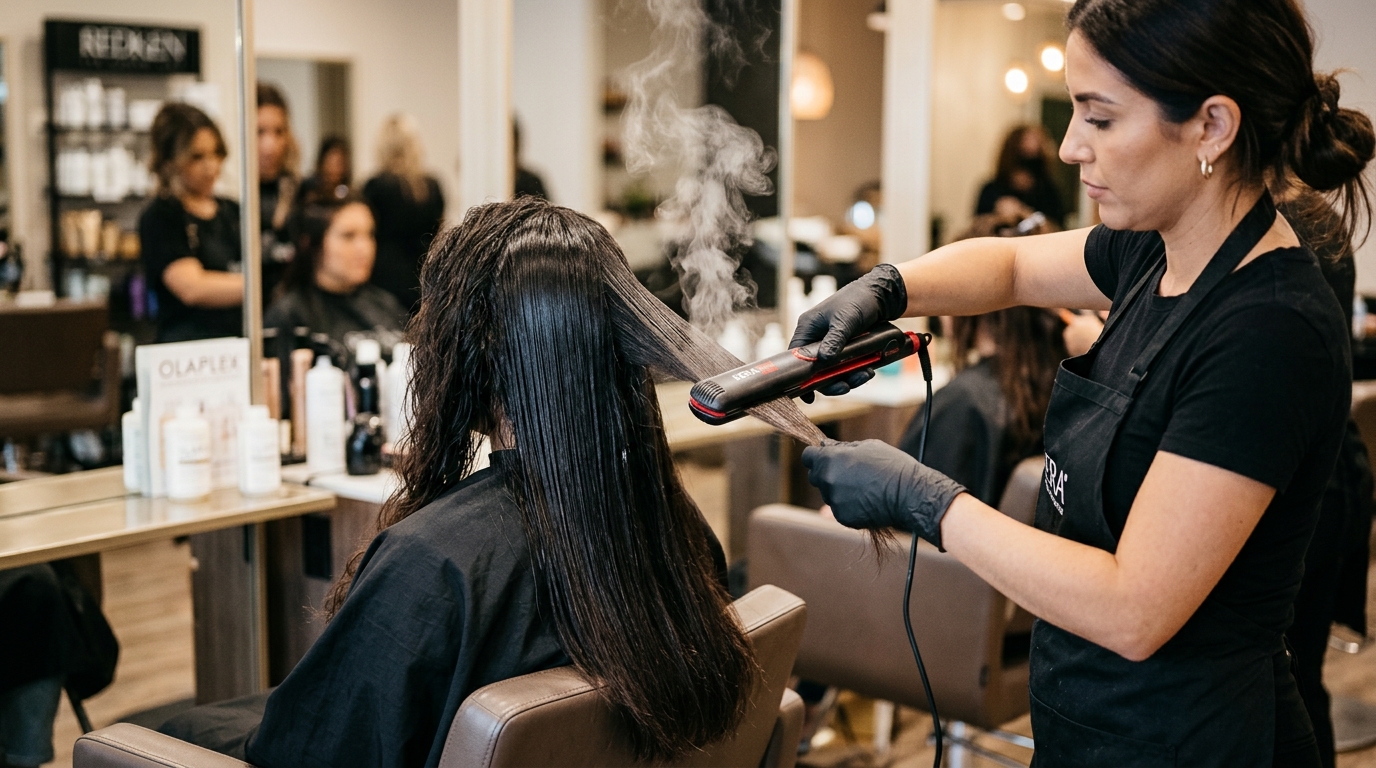
Step 4: Flat iron seal. The stylist passes a flat iron over small sections at approximately 450 degrees Fahrenheit. The heat bonds the keratin to the hair’s surface, melting it into the cuticle layer. Most stylists do 8 to 12 passes per section for thick or coarse hair, fewer for fine hair. Too few passes and the treatment won’t hold. Too many and you risk heat damage.
The result: smoother cuticle, dramatically reduced frizz, and blow-dry time cut roughly in half.
The Formaldehyde Question
This is the part most salons would rather not talk about. Some keratin treatment formulations contain formaldehyde or chemicals that release formaldehyde when heated. The most common is methylene glycol, which converts to formaldehyde gas at high temperatures (like 450 degrees from a flat iron).
Formaldehyde is the bonding agent. It is what makes the keratin stick to the hair shaft and last for months. Without it or a substitute, the treatment washes out quickly.
The health concerns are real but often overstated for clients. OSHA classifies formaldehyde as a carcinogen at sustained high concentrations. The primary risk is to salon workers who perform these treatments repeatedly, breathing in the fumes day after day. A client getting two or three treatments per year has significantly lower exposure.
That said, even single-session exposure can cause eye irritation, throat burning, and headaches in poorly ventilated salons. The concentration in some products has been measured at levels exceeding OSHA’s permissible exposure limit during the flat-ironing step.
What the FDA says: The FDA does not pre-approve cosmetic products before they go to market. They have issued multiple safety alerts about hair smoothing products containing formaldehyde, including products labeled “formaldehyde-free” that actually released it when heated. The labeling problem is widespread.
What you should do:
- Ask your stylist which specific brand they use.
- Look up the Safety Data Sheet (SDS) for that product. These are publicly available.
- If the SDS lists formaldehyde, methylene glycol, formalin, or methanediol, the product releases formaldehyde.
- “Formaldehyde-free” formulations exist and use alternative bonding agents like glyoxylic acid. They tend to produce slightly less dramatic results and may not last as long, but they avoid the chemical exposure entirely.
- Make sure the salon has adequate ventilation. A closed room with no airflow is a red flag regardless of the formula used.
See how different hairstyles look on you — upload your photo and try any style with our AI tool.
Try HairStyleMojo Free →What Results to Actually Expect
Salon marketing photos show bone-straight, glass-smooth hair. That is possible but not the default outcome for most people.
Frizz reduction: 80% to 100%. This is the headline benefit and it delivers consistently. Even in high humidity, treated hair stays smooth and controlled. If you live in a humid climate and frizz is your main issue, this alone justifies the treatment for many people.
Curl pattern: relaxed but not eliminated. Most formulations relax curls by 40% to 60%. A type 3A curl might loosen to a 2B wave. If you want curls completely gone, your stylist can use more product and more passes. If you just want frizz reduction without losing your curl pattern, that is achievable too.
Shine: significantly improved. A flat cuticle reflects light more evenly. As long as the treatment is intact, the shine is real.
Styling time: cut in half or more. A 45-minute blow dry becomes 15 to 20 minutes. Tangles decrease, brushing becomes easier, and the coated cuticle feels noticeably silkier.
What it will not do: fix split ends, reverse chemical damage, add volume, or make thin hair thicker. If your hair is severely damaged, the 450-degree flat iron step can make things worse.
How Long It Lasts
The standard range is 3 to 6 months. But that range is wide because several factors affect longevity.
Hair type is the biggest variable. Fine hair holds the treatment for a shorter period, typically 2 to 3 months. The smaller diameter means less surface area for the keratin to bond to, and it washes out faster. Coarse, thick hair holds it the longest, often pushing past 5 months.
Washing frequency matters a lot. Every wash strips a small amount of the keratin coating. Someone washing daily will burn through the treatment in 2 to 3 months. Someone washing twice a week might get 5 to 6 months.
Shampoo ingredients are critical. Sulfate-free shampoo is not a suggestion. It is mandatory if you want the treatment to last. Sulfates (sodium lauryl sulfate, sodium laureth sulfate) are aggressive detergents that dissolve the keratin bond. Switching to sulfate-free shampoo can add 4 to 6 weeks to the treatment’s lifespan.
Switch to a sulfate-free shampoo before your keratin appointment, not after. Starting sulfate-free 2 weeks early trains your scalp to produce less oil, making the treatment last longer from day one.
Salt water and chlorine accelerate fading. Regular swimmers will see the treatment degrade faster. If you swim frequently, rinse hair with fresh water before and after, and consider a swim cap for chlorinated pools.
Getting a keratin treatment and then swimming in a chlorinated pool within the first two weeks strips the coating rapidly. Chlorine is a harsh oxidizer that breaks down the protein layer before it fully bonds.
The fade is gradual. The treatment does not fall off one morning. Frizz slowly returns, starting at the roots where new growth comes in untreated. Most people notice the shift around month 3 and book their next appointment for month 4 or 5.
Cost Breakdown
Keratin treatments are a premium service. Expect to pay between $150 and $450 per session.
What drives the price:
- Hair length and thickness. Short, fine hair: $150 to $200. Medium, average thickness: $200 to $300. Long, thick hair: $350 to $450.
- Salon tier. High-end salons in major cities charge $300 to $500. Mid-range: $200 to $350. Budget salons go as low as $100 to $150, but product quality and stylist experience vary.
- Geography. New York, LA, and San Francisco run 20% to 40% above national averages.
- Product brand. Professional-grade formulations (Cezanne, Goldwell Kerasilk, Global Keratin) cost more than generic alternatives, and that gets passed to you.
Annual cost: At 2 to 3 treatments per year, expect $300 to $1,350 annually. Touch-ups cost the same as full treatments at most salons.
At-home keratin products ($15 to $40) exist but produce much weaker results. Without the 450-degree sealing step, the keratin washes out within a week or two. Useful between salon visits for a mild boost, but not a substitute.
Who Should Get One
A keratin treatment makes the most sense for specific hair types and lifestyles.
A single keratin treatment coats each hair strand with a layer of hydrolyzed protein that is only 1-3 microns thick. Yet this microscopic layer is enough to smooth the cuticle and block 80% of humidity absorption.
Frizzy hair types 2B through 3B. This is the sweet spot. Wavy to medium-curly hair that tends toward frizz responds best to keratin treatments. The curl pattern relaxes slightly, frizz drops dramatically, and the hair becomes much more manageable.
Anyone fighting humidity daily. If your hair expands into a frizz cloud every time you step outside, few solutions are more effective.
Daily blow-dryers looking to save time. If you spend 30 to 45 minutes every morning styling, the treatment cuts that significantly. Over 4 to 6 months, that adds up to hours back.
People transitioning away from chemical relaxers. Keratin treatments smooth without permanently altering the hair’s structure, making them a useful stepping stone.
Color-treated hair (with caveats). Keratin treatments help seal in color and reduce fade. Wait at least two weeks after coloring before getting the treatment. Always color first, keratin second.
Who Should Skip It
Fine or thin hair. Keratin treatments add weight and smoothness. On fine hair, that translates to flat, limp results with zero volume. If your hair already lacks body, this treatment will make it worse.
Severely damaged hair. Hair that is already breaking, splitting, and dry cannot withstand the 450-degree flat iron step. The treatment requires healthy-enough hair to tolerate intense heat. If your hair snaps when you pull on it, fix the damage first.
Anyone uncomfortable with formaldehyde exposure. Even with “formaldehyde-free” options, the labeling issues make it difficult to know exactly what you are being exposed to. If this concerns you, that is a perfectly valid reason to skip it.
Very tight curl patterns (type 4A through 4C). Keratin treatments can produce uneven results on tightly coiled hair, with some sections straightening while others stay curly. Consult a stylist who specializes in textured hair before proceeding.
Pregnant or nursing. Most dermatologists and OB-GYNs recommend avoiding keratin treatments during pregnancy and breastfeeding due to formaldehyde exposure risk. The research is limited, but the precautionary principle applies.
Aftercare That Actually Matters
Your aftercare determines whether the treatment lasts 3 months or 6 months. These are not optional suggestions.
Sulfate-free shampoo is mandatory. The single most important aftercare step. Switch before the appointment, not after. Pureology, Olaplex No. 4, and Living Proof all work well.
Wait 48 to 72 hours before washing. The keratin bond continues to set for the first few days. Washing too early shortens the treatment’s lifespan. Your hair might feel stiff during this period. Wait it out.
Avoid getting your hair wet or tucking it behind your ears for 72 hours after a keratin treatment. Any crease or bend created while the treatment is setting will become a permanent wave in that section.
No hair clips, ponytails, or tucking behind ears for 3 days. Any crease that forms during the setting period can become permanent.
Avoid salt water and chlorine. Both degrade the keratin coating. If you swim regularly, rinse with fresh water before and after, and consider a leave-in conditioner as a protective barrier.
Use a silk or satin pillowcase. Cotton creates friction that wears down the treatment. Silk helps maintain smoothness, especially around the hairline.
Keratin Treatment vs. Brazilian Blowout vs. Japanese Straightening
These three get confused constantly. They are different procedures.
Keratin treatment is the general category. A liquid keratin solution is applied, set with high heat, and sealed to the hair surface. Lasts 3 to 6 months. Fades gradually. Semi-permanent.
Brazilian Blowout is a specific brand of keratin treatment. It uses a slightly different process: the solution is applied and then immediately blow-dried and flat-ironed (no extended processing time). The heat is lower, around 380 to 410 degrees. Results are similar but slightly less dramatic. The Brazilian Blowout formula has been the subject of FDA warnings for containing methylene glycol despite being marketed as formaldehyde-free.
Japanese straightening (also called thermal reconditioning) is a completely different process. It uses thioglycolate to break and reform the disulfide bonds inside the hair shaft, permanently restructuring it. New growth comes in with your natural texture, but treated hair stays straight forever. It cannot be reversed. Takes 4 to 6 hours, costs $300 to $800, and should never be done on highlighted or bleached hair.
The quick comparison:
| Keratin Treatment | Brazilian Blowout | Japanese Straightening | |
|---|---|---|---|
| Duration | 3-6 months | 2-3 months | Permanent |
| Frizz reduction | 80-100% | 70-90% | 100% |
| Curl change | Relaxes partially | Relaxes slightly | Eliminates permanently |
| Flat iron temp | ~450F | ~380-410F | ~450F + chemical |
| Price range | $150-$450 | $150-$350 | $300-$800 |
| Reversible | Yes (fades out) | Yes (fades out) | No |
Key Takeaways
- Keratin treatments coat the hair shaft with supplemental protein, reducing frizz by 80% to 100% and cutting styling time roughly in half.
- Results last 3 to 6 months depending on hair type, washing frequency, and whether you use sulfate-free shampoo.
- The formaldehyde concern is real. Ask your stylist about the specific product, look up its Safety Data Sheet, and ensure the salon has good ventilation.
- Cost runs $150 to $450 per session, with most people needing 2 to 3 treatments per year.
- Best candidates are hair types 2B through 3B dealing with frizz and humidity. Fine hair, severely damaged hair, and very tight curl patterns are not good fits.
- Aftercare is not optional. Sulfate-free shampoo, a 72-hour no-wash period, and avoiding salt water and chlorine all extend the treatment’s life.
- Keratin treatments are semi-permanent and reversible. Japanese straightening is permanent and irreversible. These are fundamentally different procedures.
Frequently Asked Questions
The treatment itself does not cause chemical damage. However, the 450-degree flat iron step can cause heat damage on already-compromised hair. If your hair is healthy enough to tolerate flat ironing, the keratin actually protects it by sealing the cuticle. If it is severely damaged or bleached, the heat can push it past its breaking point. A good stylist will assess condition before proceeding.
Yes, and it can help seal in color and reduce fading. The key is timing: color first, wait at least two weeks, then get the keratin treatment. Never reverse the order. The keratin coating blocks color from penetrating the shaft, causing uneven results. If you plan to color after a keratin treatment, wait until it has mostly faded.
Most professionals recommend 2 to 3 times per year, spaced at least 3 months apart. Overlapping treatments can cause buildup that makes hair stiff and waxy. Let the previous treatment fade substantially before rebooking.
Formulations using glyoxylic acid as the bonding agent are genuinely formaldehyde-free. Cezanne Classic and Goldwell Kerasilk use this approach. Results are slightly less dramatic and may not last as long (closer to 2 to 4 months), but they avoid chemical exposure entirely.
Absolutely. You can curl, braid, put it up, use hot tools, and style however you want. The treatment makes your baseline smoother, not locked in place. When you wash out any styled look, hair returns to its smoother, less frizzy default. The only restriction is the first 72 hours while the bond sets.
Sources & References
- U.S. Food and Drug Administration. “Hair Smoothing Products That Release Formaldehyde When Heated.” FDA Safety Alert. (Updated 2011, 2014, 2023).
- U.S. Occupational Safety and Health Administration. Formaldehyde Standard (29 CFR 1910.1048).
- Weathersby, C., and McMichael, A. “Brazilian Keratin Hair Treatment: A Review.” Journal of Cosmetic Dermatology, vol. 12, no. 2, 2013, pp. 144–148. Review of keratin treatment effects on hair fiber properties and formaldehyde safety concerns.
- American Academy of Dermatology. “Hair Dye and Hair Relaxers.” Guidelines on chemical hair treatments including keratin smoothing services.
- Environmental Working Group. EWG Skin Deep Cosmetics Database. Hair product safety ratings and ingredient hazard assessments.
Try different hairstyles on yourself
Upload your photo and see how any hairstyle looks on you before committing.
Try HairStyleMojo Free