
Men’s Hair Types: What You Actually Need to Know
Yes, Hair Types Apply to Men Too
The Andre Walker typing system (1A through 4C) describes curl pattern. It has nothing to do with gender. A Type 3B curl behaves the same whether it’s on a woman with waist-length hair or a guy growing out a fade.
The problem is that men’s hair care content is almost universally terrible. One camp says “just use a 3-in-1 body wash” and calls it a day. The other camp prescribes a 12-step grooming ritual that reads like satire. Neither actually helps you understand why your hair does what it does.
Knowing your type eliminates most of the guesswork. It tells you which products will work, which styles are realistic, and why your friend’s routine is a disaster on your head. Everything starts here.
When using styling products, start with a small amount and add more. You can always add product, but you cannot remove it without rewashing. A dime-sized amount is enough for most short styles.
Finding Your Type with Short Hair
If you keep a buzz cut or a tight fade, you can’t see your natural curl pattern. That’s the first obstacle.
The fix: let your hair grow for three to four weeks without any product. No blow dryer, no comb, no gel. Wash it, let it air dry, and watch what happens.
Men’s hair grows about half an inch per month on average, the same rate as women’s hair. The reason men’s hair seems to grow slower is that short styles show less change per month.
Here are the tells. Straight hair lies flat or grows outward with no bends (cowlicks are the only disruption). Wavy hair develops S-shaped bends at the temples and sides. Curly hair forms spirals or ringlets, especially at the crown. Coily hair grows up and out with tight Z-patterns or small coils visible even at short lengths.
Most guys have more than one texture on their head. The crown, temples, and nape often differ. Go with whatever dominates. If your sides are 2A and your crown is 3A, treat your hair like 3A. The 2A sections will handle those products fine.
Straight Hair (Type 1) for Men

Straight hair has zero wave or curl. It falls flat from root to tip.
- 1A: Pin-straight and very fine. Almost no body. Common in East Asian hair.
- 1B: Straight with slight natural volume. The most common subtype.
- 1C: Straight but coarse and thick. Can resist styling because it doesn’t like to bend.
The oil situation. Sebum travels from your scalp down the hair shaft with nothing to slow it. No curves, no bends. By mid-afternoon, your hair can look wet even though you washed it that morning. This hits 1A hardest and 1C least.
Most men overwash their hair. Unless you have an oily scalp, washing every 2-3 days with a sulfate-free shampoo preserves natural oils and actually makes styling easier because hair has more grip.
Wash daily or every other day. Straight hair handles frequent washing better than any other type because it replaces oil fast. Matte clay and paste give texture and hold without the wet-look shine that makes already-oily hair look worse. Dry shampoo between washes absorbs excess oil and adds grip.
Skip pomade, skip oil-based products, skip anything marketed as “high shine.” You already have shine from the oil your scalp is producing. Adding more just accelerates the greasy look.
See how different hairstyles look on you — upload your photo and try any style with our AI tool.
Try HairStyleMojo Free →Wavy Hair (Type 2) for Men
Wavy hair is the sweet spot for men’s styling. You have natural movement and texture without the maintenance that curls demand.
- 2A: Loose, subtle waves. Fine hair with a gentle S-pattern. Easy to enhance, easy to straighten.
- 2B: More defined S-waves starting from mid-length. Moderate volume and body.
- 2C: Strong waves bordering on curly. Thicker, frizz-prone, harder to control.
Here’s the core insight: your hair already has texture. You don’t need to create it. You just need to stop destroying it.

Sea salt spray is practically made for Type 2. A few spritzes on damp hair enhance your natural wave pattern, add grip, and create that “I woke up like this” look. Light-hold gel or texturizing cream handles more structured styles. Air drying beats blow drying because heat can relax the wave pattern.
The one thing to avoid: over-brushing. A brush through dry wavy hair breaks up the wave pattern and gives you a puffy, shapeless mess. Detangle in the shower with conditioner and a wide-tooth comb. Once your hair is dry, use your fingers or leave it alone. Second-day wavy hair often looks better than freshly washed because natural oils enhance the wave definition.
Curly Hair (Type 3) for Men
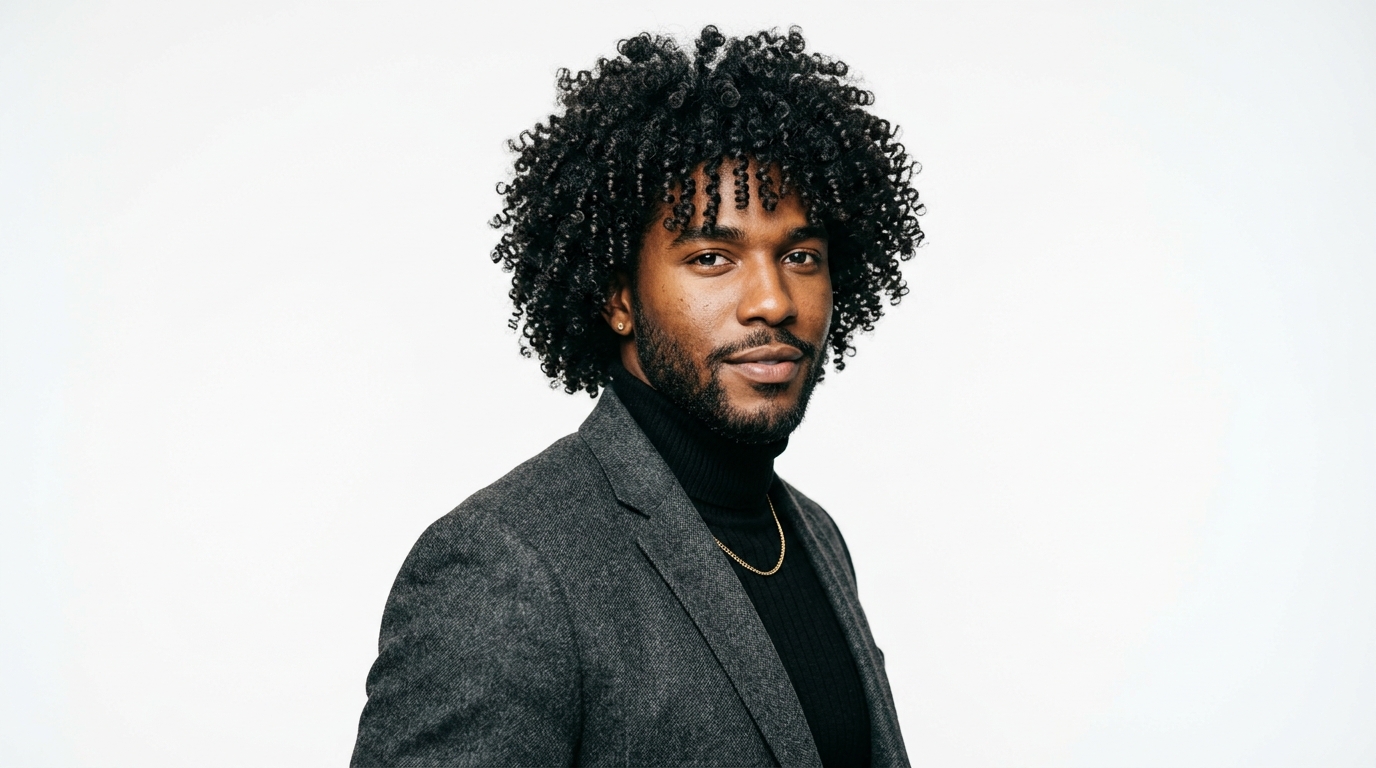
Type 3 forms definite spirals and ringlets. This is also where most men’s hair care advice fails completely, because most barbers are trained primarily on straight and wavy textures.
- 3A: Loose, shiny curls about marker-width. Springy with defined loops.
- 3B: Tighter ringlets, roughly pen-width. More volume, more frizz, more shrinkage (your hair looks shorter than it actually is).
- 3C: Tight corkscrews, pencil-width or smaller. Dense and highly prone to dryness.
Do not brush curly hair when it’s dry. This is not a suggestion. Dry-brushing destroys curl clumps, causes breakage, and turns your head into a frizz cloud. Detangle only when wet with conditioner, using your fingers or a wide-tooth comb.
Conditioner is not optional. Curly hair is structurally drier than straight hair. The twists in each strand prevent sebum from coating the full length. Shampoo alone strips what little oil your curls get.
The routine that works: shampoo two to three times per week with a sulfate-free formula. Co-wash (conditioner only) on the other days. Apply leave-in conditioner to soaking wet hair right out of the shower. For longer styles, layer a medium-hold gel on top, scrunch sections upward toward your scalp, and don’t touch your hair until it’s fully dry. Once dry, scrunch out the gel cast (the crunchy shell) for soft, defined curls.
Using 2-in-1 shampoo and conditioner products robs hair of proper conditioning. The cleansing and conditioning agents cancel each other out, leaving hair neither clean nor moisturized. Use them separately.
For shorter styles, a curl cream finger-styled into damp hair gives natural definition without stiffness.
Coily Hair (Type 4) for Men
Type 4 has the tightest curl pattern. Tight coils, Z-shaped angles, or texture so dense there’s no visible curl definition without manipulation. It’s the most fragile type and the most prone to dryness. It’s also incredibly versatile once you know how to work with it.
- 4A: Defined, springy coils about crochet-needle width. Visible S-pattern.
- 4B: Z-shaped bends rather than circular coils. Less defined pattern, significant shrinkage (50-75% shorter than actual length).
- 4C: Tightest texture. Very little visible definition without styling. Extremely dense and fragile.
Moisturize. Then moisturize again. Sebum barely travels past the first bend in coily hair. Without external moisture, the hair becomes brittle and breaks.

Deep condition weekly. Use a heavy mask, apply generously, and leave it on for 15 to 30 minutes with heat if possible. Your hair will feel completely different afterward.
Finger detangle only, on wet, conditioned hair. Combs and brushes cause breakage. Sleep on a satin or silk pillowcase. Cotton absorbs moisture overnight and creates friction that causes breakage. A satin pillowcase is a $10 fix that makes a visible difference within a week.
For locs: patience during the starter phase, retwisting every four to six weeks. For twist-outs: twist damp hair overnight, unravel in the morning for defined curl patterns. Both require consistent moisture to look good and stay healthy.
Avoid sulfate shampoos (use sulfate-free or co-wash), towel-drying with cotton (use microfiber or a t-shirt), and tight styles that pull on the hairline. Traction alopecia is real and permanent.
Products by Hair Type
Stop buying products because the packaging looks cool. Match your product to your type.
Type 1 (Straight): Matte clay, matte paste, dry shampoo, lightweight volumizing spray. Nothing that adds shine.
Type 2 (Wavy): Sea salt spray, light-hold gel, texturizing cream. Nothing heavy that weighs waves down.
Type 3 (Curly): Leave-in conditioner (essential), medium-hold gel, curl cream. Sulfate-free shampoo only. Skip anything with drying alcohols (isopropyl, ethyl alcohol on the label).
Type 4 (Coily): Heavy moisturizer or hair butter (shea, mango), natural oils for sealing (jojoba, argan, castor), deep conditioning mask. Skip light products that evaporate quickly and provide no lasting moisture.
Universal rule: Start with less product than you think you need. You can always add more. You cannot subtract.
Hair Type and Thinning
Your type doesn’t cause thinning. Androgenetic alopecia is genetic and hormonal. But type dramatically affects how thinning looks and when you notice it.
Men with receding hairlines should avoid slicking hair back, which emphasizes the hairline. Instead, textured crops and forward-swept styles create the illusion of fullness where it matters most.
Fine, straight hair (1A/1B) shows thinning earliest. No curl pattern creates volume or coverage. When density drops, you see scalp immediately, especially under overhead lighting. Many straight-haired men notice thinning in their early twenties even when actual loss is still mild.
Male pattern hair loss affects roughly 50% of men by age 50 and is determined primarily by genetics from your mother’s side. The gene for androgen receptor sensitivity sits on the X chromosome.
Wavy hair (Type 2) has a natural volume buffer. The wave pattern creates more visual coverage per strand. Thinning happens at the same rate but takes longer to become visible.
Curly hair (Type 3) adds significant volume per strand. A single curl takes up more visual space than a straight hair. Thinning can go unnoticed for years, which means by the time you notice, density loss may be more advanced than you’d expect.
Coily hair (Type 4) provides similar visual coverage, but traction alopecia is an additional risk specific to this type. Heavy locs, tight braids, or consistently pulled-back styles can cause permanent hair loss at the hairline and edges.
Regardless of type, if your part is widening, your hairline is creeping back, or you see more scalp through the top, talk to a dermatologist sooner rather than later. Finasteride and minoxidil work across all hair types, and earlier intervention preserves more hair. Don’t let anyone sell you a supplement without clinical evidence. Talk to a doctor, not an influencer.
Key Takeaways
- The 1A-4C typing system works the same for men. Let hair grow three to four weeks unstyled to find your natural texture.
- Straight hair fights oil; curly and coily hair fight dryness. Your entire product strategy follows from this.
- Never brush curly or coily hair dry. Detangle only when wet with conditioner.
- Match products to type: matte clay for Type 1, sea salt spray for Type 2, leave-in conditioner for Type 3, heavy moisturizer for Type 4.
- Hair type affects when and how thinning becomes visible. Fine straight hair shows it first; coily hair can mask it for years.
Frequently Asked Questions
Grow it out for three to four weeks without product or heat styling. Your natural texture will show, especially at the temples and crown. Cowlicks suggest straight. S-bends suggest waves. Spirals or tight coils indicate Type 3 or 4.
Your genetic type stays the same, but hormones, aging, and medication can alter how your hair behaves. Many men notice their hair getting finer or losing some curl pattern as they age. If your texture has shifted dramatically, mention it to your doctor.
Yes. Types 3 and 4 benefit from conditioner at every wash. Many men with these types co-wash (conditioner only) most days and use shampoo just once or twice per week.
Straight hair releases hold faster because there’s no texture for product to grip. Wavy and curly hair naturally hold styles longer because bends and coils create friction. Type 1 guys often need stronger-hold products, while Type 3 and 4 can use lighter ones.
It’s a starting point. The system describes curl pattern but ignores porosity (how well hair absorbs moisture), density (strands per square inch), and thickness (width of individual strands). Two guys with Type 3A can have completely different needs based on these factors. Use the type as a baseline, then adjust based on how your hair actually responds.
Sources & References
- Walker, A. Andre Talks Hair! Simon & Schuster, 1997.
- Loussouarn, G., et al. “Diversity in human hair growth, diameter, colour and shape.” European Journal of Dermatology, vol. 26, no. 2, 2016, pp. 144-154.
- Khumalo, N.P., et al. “What is normal Black African hair?” Journal of the American Academy of Dermatology, vol. 43, no. 5, 2000, pp. 814-820.
- Gavazzoni Dias, M.F. “Hair Cosmetics: An Overview.” International Journal of Trichology, vol. 7, no. 1, 2015, pp. 2-15.
- Piraccini, B.M., and Alessandrini, A. “Androgenetic Alopecia.” Giornale Italiano di Dermatologia e Venereologia, vol. 149, no. 1, 2014, pp. 15-24.
Try different hairstyles on yourself
Upload your photo and see how any hairstyle looks on you before committing.
Try HairStyleMojo Free