
Protective Hairstyles for Sleeping: Keep Your Hair Safe Overnight
You spend a third of your life in bed. During that time, your hair is on its own. No products, no supervision, no gentle hands detangling it. Just your head grinding against a pillow for eight straight hours.
Most people never think about what that does to their hair. They should.
Why Your Hair Needs Protection While You Sleep
The average person shifts position 40 to 50 times per night. Every toss, every turn, every adjustment drags your hair across the pillowcase surface. Cotton fabric, which is what most pillowcases are made from, has a rough texture at the fiber level. Under a microscope, cotton fibers look like twisted ribbons with ridges and grooves that catch and pull at the hair cuticle.
That friction lifts the cuticle scales along each strand. Lifted cuticles mean tangles, because raised edges hook onto neighboring strands like velcro. Tangles mean you rip through them with a brush the next morning, snapping weakened hairs in the process.
One night of this won’t destroy your hair. But multiply it by 365. Then multiply that by years. The cumulative effect is real, and if the damage has already built up, you may need a full damaged hair recovery plan to get back on track. Studies published in the Journal of Cosmetic Science have documented how repeated mechanical friction is a significant contributor to cuticle erosion and hair breakage, particularly along the hairline and at the nape where contact with the pillow is heaviest.
The fix is simple. Reduce friction, reduce movement, or both. That’s what protective sleeping hairstyles do. These are a specific subset of protective hairstyles — styles designed to prevent mechanical damage to your hair.
For Straight and Wavy Hair
Straight and wavy hair tangles easily at night because individual strands slide over each other and knot up. The goal is to keep strands organized without creating tension.
Loose Low Braid
This is the most reliable option. Gather your hair at the nape, divide it into three sections, and braid loosely. Secure the end with a satin scrunchie. Not a rubber elastic. Not a metal-clasp hair tie. A satin scrunchie. The braid keeps strands from crossing over each other and tangling, while the low placement means zero tension on your hairline.
Use a loose silk scrunchie instead of a regular elastic band. Standard elastics create a pressure point that dents and weakens the hair shaft. Silk scrunchies distribute tension evenly and prevent crease marks.
The key word is loose. You are not braiding for hold or style. You are braiding to keep hair organized while it lies flat behind you. If the braid feels tight, redo it looser.
Satin and silk pillowcases reduce hair friction by up to 40% compared to cotton. If you do nothing else for your hair, switching your pillowcase is the single highest-impact, lowest-effort change you can make.
For straight or fine hair, a loose braid is better than a top bun for sleeping. It prevents tangling without creating the root tension that causes breakage in fine strands.
Low Ponytail with Satin Scrunchie
Even simpler. Pull your hair back into a low, loose ponytail at the nape. Use a wide satin scrunchie. Leave it loose enough that you could easily slide two fingers between the scrunchie and your hair. This keeps everything together without the structure of a braid.
This works best for hair that doesn’t tangle severely. If you wake up with serious knots even in a ponytail, switch to the braid.
What to Avoid
High ponytails create tension at the crown. Tight buns pull at the hairline. Anything secured with a thin elastic leaves a dent and creates a pressure point where breakage concentrates. Sleeping with hair completely loose works fine for some people, but if you move a lot at night, loose hair will mat and tangle.
For Curly Hair
Curly hair has different needs. The curl pattern creates natural volume that gets crushed when you sleep on it. Crushed curls lose definition, flatten on one side, and frizz from friction. The goal is keeping curls intact and off the pillow surface.
The Pineapple
The single most popular protective sleeping style for curly hair, and for good reason. Flip your head forward and gather all your hair at the very top of your head. Secure it with one large satin scrunchie. That’s it.
The name comes from how it looks: a fountain of curls sprouting from the top of your head. When you lie down, the curls fall behind you on the pillow instead of getting crushed underneath your head. In the morning, remove the scrunchie, flip your head forward, and shake gently. Your curl pattern stays mostly intact.
Two critical rules. First, the scrunchie must be loose. If you pull it tight, you’ll crush the curls at the gathering point and wake up with a visible crease. Second, the placement must be high. If you gather at the crown instead of the very top, curls on the back of your head still get compressed against the pillow.
Medusa Clipping
Named after, well, Medusa. Section your hair into five or six large sections. Twist each section loosely and clip it up with a large claw clip or duckbill clip. The result is multiple sections of curls held up and away from the pillow in different directions.
This works especially well for medium-length curls that aren’t long enough for a proper pineapple. It also distributes the curls more evenly, so you don’t end up with one big crush point at the top of your head.
The pineapple method works best for curly hair: gather all hair loosely at the very top of your head with a silk scrunchie. This keeps curls intact and prevents flattening from sleeping on them.
Use clips without sharp teeth or metal edges. Smooth plastic claw clips are ideal.
Two Loose Braids
When your curls are tangling overnight despite the pineapple, two loose braids give you more control. Part your hair down the middle, braid each side loosely, and secure with satin scrunchies. This prevents tangling and provides a slight stretch to the curl pattern, which some people prefer for second-day styling.
The tradeoff: braids will loosen your curl pattern slightly. If you want maximum curl definition in the morning, stick with the pineapple.
See how different hairstyles look on you — upload your photo and try any style with our AI tool.
Try HairStyleMojo Free →For Coily Hair
Coily hair (type 4) is the most vulnerable to nighttime friction. The tight curl pattern creates more surface area for friction to act on, and the strands are naturally finer and more prone to breakage. Protection here isn’t optional. It’s essential.
Satin Scarf Wrap
This is the gold standard for coily hair protection. Fold a large satin scarf into a triangle. Place the long edge along your forehead, bring the two ends around to the back, cross them, bring them forward, and tie at the front or tuck the ends in. Your hair should be completely enclosed.
The scarf does two things. It eliminates all contact between your hair and the pillowcase. And it prevents your hair from moving, which means zero friction, zero tangling, zero frizz. Nothing else protects as completely.
For best results, apply your nighttime moisturizer or oil before wrapping. The scarf traps the product against your hair, giving it hours to absorb.
Satin Bonnet
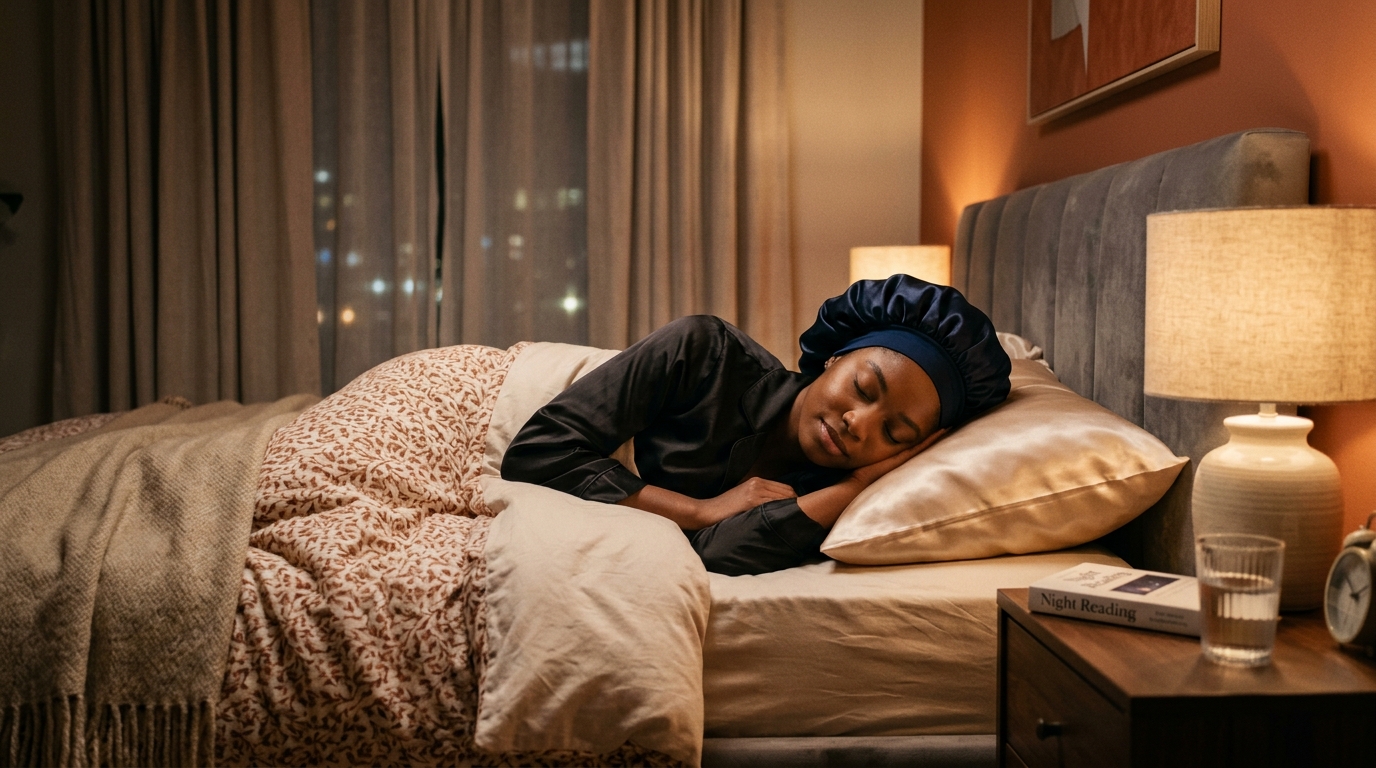
Same principle, less technique. A satin bonnet slips on over your hair and stays put through the night. Look for one with an adjustable elastic band. Standard bonnets with fixed elastic tend to slide off during sleep, especially if you move a lot. An adjustable drawstring lets you tighten it just enough to stay on without leaving marks on your forehead.
You move your head an average of 20-30 times during a normal night of sleep. Each movement creates friction between your hair and the pillowcase, which is why morning tangles happen even when you go to bed with smooth hair.
Bonnets are the fastest option. Five seconds to put on. Done.
Two-Strand Twists
If you want to style and protect simultaneously, two-strand twists are the move. Section your hair, twist each section into a two-strand twist, and pin them flat to your head with bobby pins. Cover with a satin bonnet or scarf.
In the morning, you can either unravel the twists for a defined twist-out or leave them in as a style. This doubles as a styling technique and a protective measure.
The Pineapple (Modified)
If your coily hair is long enough to gather at the top of your head, the pineapple works here too. Combine it with a satin bonnet over the top for maximum protection.
Your Pillowcase Matters More Than You Think
You can do everything right with your hairstyle and still damage your hair if you’re sleeping on cotton. The pillowcase is half the equation.
Cotton terry fabric has a rough, absorbent surface. It creates friction against hair, and it absorbs moisture from your strands overnight, leaving them drier by morning. This is why your hair feels rougher and more tangled when you sleep on cotton versus satin.
Both satin and silk solve this problem, but they are not the same thing. Silk is a natural protein fiber produced by silkworms. A silk pillowcase costs $40 to $80. Satin is a weave pattern, not a material. Most satin pillowcases are polyester. A satin pillowcase costs $8 to $15.
The friction reduction is essentially the same. Both surfaces allow hair to glide rather than catch. Research on fabric friction coefficients shows that both silk and satin-weave polyester produce significantly less friction against hair than cotton. Unless you want the luxury feel of real silk, satin gives you the same hair protection at a fraction of the cost.
Replace your cotton pillowcase. This single change reduces overnight friction regardless of what hairstyle you use.
Scrunchies, Elastics, and Clips: What to Use and What to Avoid
The accessories you use to secure your sleeping hairstyle matter just as much as the style itself.
Never use rubber bands or thin elastics with metal clasps. These create concentrated pressure points on the hair shaft. Hours of sustained pressure in one spot weakens the hair and causes breakage exactly where the elastic sits. This is why people who sleep in tight ponytails often notice breakage at ponytail-height.
Satin scrunchies are the best option for any style that needs a tie. They’re wide, which distributes pressure over a larger area. The satin surface doesn’t grip or pull. And they have no metal parts to snag strands.
Claw clips work well for medusa clipping and updo-style protection. Choose clips with smooth, rounded teeth rather than sharp, thin ones. Large clips hold sections better and create less concentrated pressure.
Bobby pins are fine for securing twists or pinning sections flat. The key is removing them gently in the morning. Slide them out in the direction they were inserted. Pulling them straight up rips hair.
The 30-Second Bedtime Routine
No one is going to spend 20 minutes prepping their hair for bed every night. That’s why the best protective hairstyles are fast.
Straight or wavy hair: Loose braid + satin pillowcase. Thirty seconds. Braid loosely, secure with satin scrunchie, lie down.
Curly hair: Pineapple + satin pillowcase. Fifteen seconds. Flip head, gather at the top, secure with satin scrunchie.
Coily hair: Satin bonnet. Five seconds. Slip it on. Done.
The satin pillowcase is the constant across all hair types. Even if you forget to style your hair before bed, the pillowcase alone reduces friction significantly. Start there if you start nowhere else.
Consistency beats perfection. Protecting your hair six nights out of seven does more than a perfect routine you abandon after a week. Pick the simplest method that works for your hair type and make it automatic.
Key Takeaways
- Overnight friction from tossing and turning causes cumulative breakage, tangles, and frizz over time
- Straight and wavy hair benefits most from a loose low braid secured with a satin scrunchie
- Curly hair stays defined with the pineapple method: hair gathered loosely at the very top of your head
- Coily hair needs full coverage protection like a satin scarf wrap or bonnet
- Satin pillowcases reduce friction just as well as silk at a fraction of the cost
- Never use rubber bands, thin elastics, or metal-clasp hair ties for sleeping
- The best routine is the one you actually do every night; simplicity wins
Frequently Asked Questions
Yes, but not for the reason most people think. Wet hair doesn’t cause illness. However, wet hair is significantly weaker than dry hair because water disrupts the hydrogen bonds inside the strand. Friction that dry hair could handle without issue can break wet strands. If you must sleep with damp hair, braid it loosely and always use a satin pillowcase.
Sleeping with wet hair in a tight bun or braid causes breakage because wet hair is 30% weaker than dry hair. If you must sleep with damp hair, leave it loose on a silk pillowcase or in a very loose braid.
A properly loose pineapple should not stretch your curls. If you’re noticing elongation at the gathering point, your scrunchie is too tight. The pineapple should feel like your hair is barely being held. If you shake your head gently and the scrunchie stays in place, it’s loose enough.
Wash it weekly, just like a cotton pillowcase. Replace it when the surface starts to feel rough or pilled, which typically happens after six to twelve months of regular use. A worn satin pillowcase loses its low-friction benefit.
Absolutely. A bonnet provides even better protection than a pillowcase because it moves with your head, so your hair never contacts the pillow surface at all. Many people use both for maximum protection. If you choose only one, a bonnet protects more completely; a pillowcase is easier to keep on all night.
They don’t directly stimulate growth. Your hair grows from the follicle at a genetically determined rate regardless of what you do at night. But protective sleeping styles significantly reduce breakage, which means you retain more of the length your hair grows. Reduced breakage is the single biggest factor in perceived hair growth for most people.
Sources & References
- Robbins, C.R. Chemical and Physical Behavior of Human Hair. 5th ed. Springer, 2012.
- Draelos, Z.D. “Hair cosmetics.” Dermatologic Clinics, vol. 19, no. 1, 2001, pp. 167-176.
- Syed, A.N., et al. “Fiber friction and styling of human hair.” Journal of Cosmetic Science, vol. 54, no. 5, 2003, pp. 459-468.
- Gavazzoni Dias, M.F. “Hair cosmetics: An overview.” International Journal of Trichology, vol. 7, no. 1, 2015, pp. 2-15.
- Seshadri, I.P., and Bhushan, B. “Effect of rubbing load on nanoscale hair conditioner thickness distribution on hair surface.” Journal of Colloid and Interface Science, vol. 325, no. 2, 2008, pp. 472-479.
Try different hairstyles on yourself
Upload your photo and see how any hairstyle looks on you before committing.
Try HairStyleMojo Free