
How to Repair Damaged Hair: A Realistic Recovery Plan
Every shampoo bottle promises to “repair” and “restore.” Every salon treatment claims to “rebuild from within.” And you keep buying because your hair feels like straw and you want it fixed.
Relying solely on hair masks and overnight treatments without addressing the cause of damage is like bailing water from a leaking boat. Identify what is causing the damage (heat, chemicals, friction) and stop that first.
Here’s what no product label will tell you. Hair is dead. Every strand on your head is dead keratin tissue from the moment it pushes past your scalp. It cannot heal. It cannot regenerate.
That sounds bleak, but it’s the most useful thing you’ll learn about hair care. Once you stop chasing miracle cures and start working with biology, you can build a plan that actually works. For the full science of how hair works, see our complete guide to hair health.
The Honest Truth About Hair “Repair”
The hair shaft is made of keratin, organized in three layers: the cuticle (outer protective shingles), the cortex (structural core), and the medulla (a thin center channel). The cuticle is your hair’s armor. When it’s intact, hair looks shiny and resists breakage. When it’s damaged, everything falls apart.
Identify your damage type before choosing a treatment. Protein-damaged hair (stiff, straw-like) needs moisture. Moisture-damaged hair (limp, gummy when wet) needs protein. Getting this backwards makes things worse.
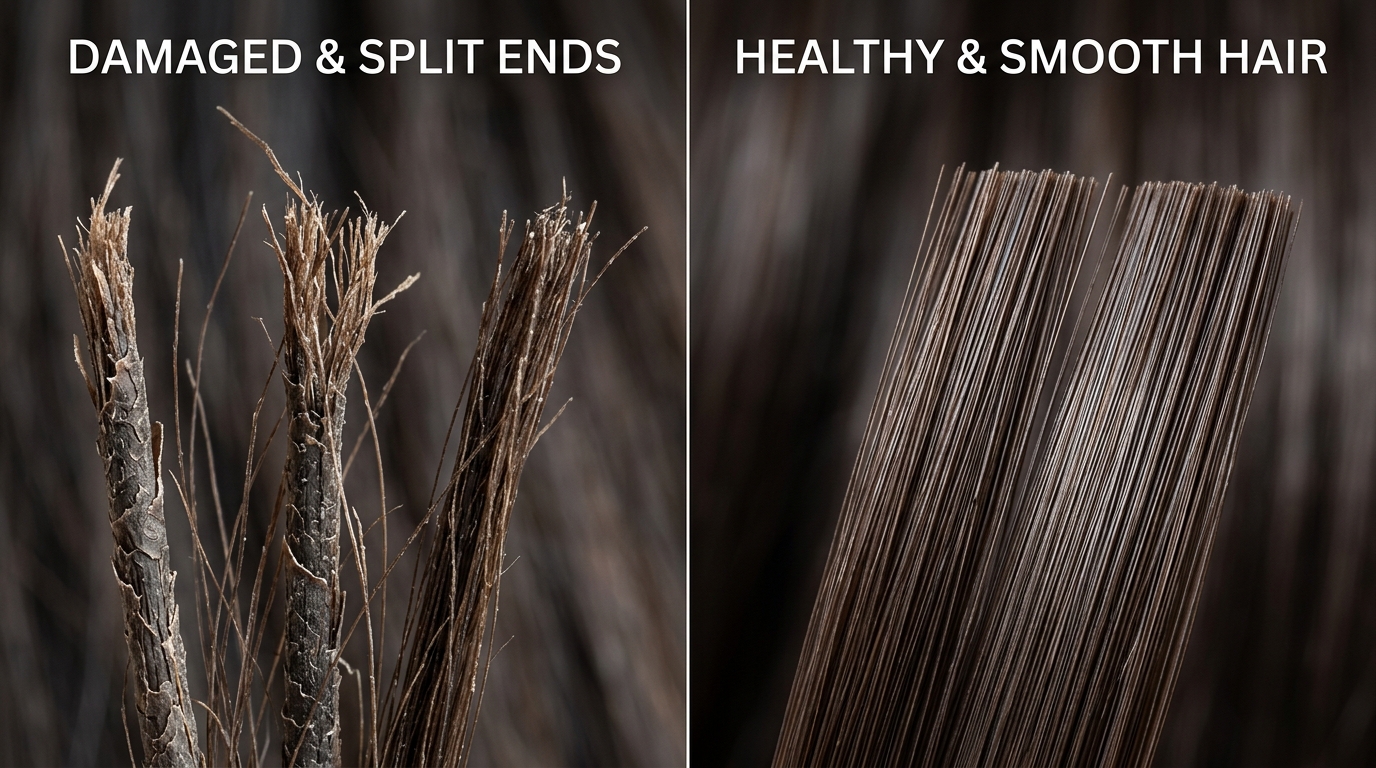
Unlike skin cells, hair cells are not alive. There is no blood supply to the strand, no cellular repair mechanism. When the cuticle gets chipped or the cortex loses protein bonds, those structures stay broken. Robbins documented this extensively in Chemical and Physical Behavior of Human Hair.
So what do “repair” products actually do? They temporarily fill gaps, coat the surface, and improve how hair looks and feels. Some, like bond-repair treatments, reconnect broken chemical bonds inside the cortex. Real improvements, but they wash out over time. Maintenance, not a cure.
The only true repair is growing new, undamaged hair from the follicle and protecting it from day one. This plan does two things: manage existing damage and prevent damage to new growth.
Assess Your Damage Level
Not all damage is equal. Your plan depends on where you fall.
Mild damage. Some dryness and frizz. Hair tangles a bit more than it used to. The cuticle is roughened but mostly intact. Color fades slightly faster. This is where most people land after a few years of regular heat styling without protection.
Moderate damage. Noticeable breakage when you brush. Split ends visible without a magnifying glass. Hair tangles easily and feels rough between your fingers. Color fades within two weeks of dyeing. The cuticle has significant gaps, and the cortex is partially exposed.
Severe damage. Structural failure. Hair feels gummy or stretchy when wet. Strands snap with minimal tension. You can see thinning from breakage, not shedding. When you pull a wet strand, it stretches like taffy and doesn’t spring back.
If you’re in the severe category, no product will bring those strands back. You need a significant trim before treatments can do anything meaningful. Cutting 2 to 3 inches of structurally failed hair saves you months of watching it slowly disintegrate anyway.
Step 1: Stop the Bleeding
Before you add a single treatment, stop causing more damage. This is the most important step and the one people skip. They buy the expensive bond-repair kit and then blast their hair with a 450-degree flat iron the next morning. That’s like taking vitamins while smoking a pack a day.
Lower your heat. Drop your flat iron and curling iron to 300 to 350 degrees Fahrenheit. Fine or damaged hair should stay at the low end. Research by Ruetsch et al. in the Journal of Cosmetic Science showed that thermal damage to the cuticle increases sharply above 300 degrees.
Switch to sulfate-free shampoo. Sodium lauryl sulfate and sodium laureth sulfate strip sebum aggressively. That’s harsh on already-damaged cuticles. A gentler cleanser gives your hair a chance to retain its natural oils.
Pause chemical treatments. Stop coloring, bleaching, perming, or relaxing. Each chemical process forces the cuticle open. On already-compromised hair, the damage compounds fast. The American Academy of Dermatology recommends waiting until hair has recovered before resuming chemical services.
A single bleaching session can reduce hair tensile strength by up to 60%. This is why bleached hair stretches and snaps rather than bouncing back. The internal protein structure has been fundamentally weakened.
Ditch the cotton towel. Cotton terry cloth snags cuticle scales, especially on wet hair when the cuticle is swollen and vulnerable. Switch to a microfiber towel or an old t-shirt. Squeeze gently. Never rub.
Sleep on satin or silk. A satin pillowcase reduces friction by roughly 40 percent compared to cotton. Eight hours of reduced friction every night adds up fast.
These changes cost almost nothing. They just require you to stop doing things that feel normal but are causing measurable damage every day.
See how different hairstyles look on you — upload your photo and try any style with our AI tool.
Try HairStyleMojo Free →Step 2: Protein Treatments
Damaged cuticles have physical gaps where keratin has broken down. Hydrolyzed protein treatments deposit small protein molecules into those gaps, making the cuticle lie flatter. Hair feels stronger, looks smoother, and resists breakage better.
This isn’t permanent. The deposited proteins wash out over several shampoos. But consistent use keeps the cuticle surface closer to intact than it would be on its own.
What to use. Aphogee Two-Step Protein Treatment is the gold standard for moderate to severe damage. It forms a rigid coating and works noticeably in a single application. For milder damage, Olaplex No. 0 combined with No. 3 offers a gentler combination.
Bond-repair treatments like Olaplex No. 3 work at the molecular level by reconnecting broken disulfide bonds inside the hair cortex. Use it as a pre-shampoo treatment once a week for genuinely damaged hair.
Frequency. Once a week for four weeks. Then every two weeks for maintenance.
The protein-moisture balance. This is critical. Too much protein makes hair stiff, brittle, and prone to snapping. If your hair starts feeling like straw, you’ve overloaded on protein and need to shift to moisture-focused treatments immediately. Hair needs both protein for structure and moisture for flexibility.
Step 3: Bond Repair
Bond-repair treatments are different from protein treatments, and the distinction matters.
Inside the cortex, keratin chains are connected by disulfide bonds. These strong chemical bonds give hair its shape and strength. Heat, bleach, and mechanical stress break them. When enough snap, the hair loses its structural integrity.
Olaplex’s active ingredient, bis-aminopropyl diglycol dimaleate, reconnects broken disulfide bonds. It’s a small molecule that finds broken bond sites and re-links them inside the cortex, not on the cuticle surface. Peer-reviewed studies confirm measurably stronger hair after treatment.
The chemistry is real, but it has limits. Bond repair reconnects some broken bonds, not all. Severely damaged hair has lost so much structural material that there isn’t enough left to reconnect meaningfully.
How to use it. Apply Olaplex No. 0 to dry hair as a primer. Follow with No. 3 and leave on for at least 10 minutes (up to 30 for severe damage). Rinse and follow with your regular shampoo and conditioner. Use this as a pre-wash treatment once a week.
Other bond-repair products exist. Redken Acidic Bonding Concentrate, K18 Leave-In Molecular Repair Hair Mask, and professional keratin treatments all target internal bond structures using different active ingredients. K18 uses a bioactive peptide to reconnect both disulfide and hydrogen bonds. Results vary, but the category as a whole delivers real structural improvements.
Hair can absorb up to 30% of its weight in water. When damaged hair absorbs too much water and then dries, the repeated swelling and shrinking causes a phenomenon called hygral fatigue, which progressively weakens the strand.
Step 4: Deep Conditioning
Protein gives structure. Moisture gives flexibility. You need both.
Damaged hair loses moisture rapidly because the cuticle can’t retain it — a condition known as high porosity. Water molecules escape through the gaps, leaving hair dry, stiff, and prone to cracking. Deep conditioning floods the hair with moisture-binding ingredients that temporarily restore flexibility.
How to do it. Apply a deep conditioning mask to clean, damp hair. Cover with a plastic cap or warm towel to open the cuticle slightly. Leave on for 15 to 30 minutes. Rinse with cool water to help the cuticle close.
What to look for. Fatty alcohols (cetyl, cetearyl) coat and smooth the cuticle. Natural oils (argan, jojoba, avocado) provide lipids that mimic sebum. Glycerin draws moisture in. Panthenol (provitamin B5) penetrates the cortex and improves moisture retention from the inside.
Frequency. Once a week. On protein treatment weeks, deep condition afterward to restore balance.
The strand test. Not sure if you need protein or moisture? Pull a wet strand gently. If it stretches and breaks, it needs protein. If it snaps immediately with no stretch, it needs moisture. Healthy hair stretches slightly and bounces back.
Step 5: Strategic Trimming
Split ends are not just cosmetic. They’re structural failures that travel up the shaft if left uncut. Once a split starts, nothing stops it from migrating upward. An untrimmed split end can travel two to three inches up the strand before it breaks off.
The plan. Trim one-quarter to one-half inch every six to eight weeks. This removes the most damaged ends before splits can travel. You’re not losing length in any meaningful way. You’re preventing existing damage from destroying more of the strand.
If damage is severe, consider a bigger initial trim of one to two inches. The hair that remains will respond much better to treatments because it still has enough structural integrity to benefit.
Ask your stylist about “dusting” if you want to preserve length. Dusting involves twisting sections and snipping only the split ends that poke out from the twist. More precise than a standard trim.
Step 6: Protect New Growth
Everything above is damage management. The real strategy is what happens next.
Your scalp is growing new hair at roughly half an inch per month. That new growth emerges with an intact cuticle and full structural integrity. Your job is to keep it that way.
Heat protectant every single time. No exceptions. Heat protectants form a barrier that absorbs and distributes thermal energy before it reaches the cuticle. They reduce heat damage by up to 50 percent according to published testing. Skip the protectant and you’re undoing your recovery plan at the root.
Gentle detangling. Start from the ends and work up. Use a wide-tooth comb on wet, conditioned hair. Never rip through a tangle.
Protective styles when practical. Loose braids, buns, and twists reduce friction from wind, clothing, and movement. Everyday mechanical wear is a real source of cuticle damage, especially on longer hair.
UV protection. Sun exposure degrades the cuticle and oxidizes melanin (which is why hair lightens in summer). If you spend significant time outdoors, use a leave-in product with UV filters or wear a hat.
Protect your hair from the sun just like your skin. UV radiation breaks down both melanin and protein in the hair shaft. Wear a hat or use a UV-protectant spray during prolonged sun exposure.
Give this plan 6 to 12 months. Hair grows about six inches per year. As damaged lengths get trimmed away and new growth stays protected, you’ll see a gradual but unmistakable transformation. The line of demarcation between old and new hair will be visible.
Timeline Expectations
Be realistic. Hair biology sets the pace, not your product budget.
Weeks 2 to 4. Texture improvement. Hair feels softer, smoother, less rough. This is the protein and conditioning treatments doing surface-level work. You’ll notice less breakage during brushing.
Weeks 4 to 8. Strength improvement. Strands resist pulling better. Fewer hairs on your brush. Split ends slow down.
Months 3 to 6. Visible difference. New growth starts to show, especially at the roots where healthier texture contrasts with older lengths. Trims have removed the worst ends. Hair holds styles better and retains color longer.
Months 6 to 18. Full recovery. This depends on your length and damage severity. Shoulder-length hair turns over in about two years. Moderate damage with regular trims can reach mostly healthy hair within a year. The math is simple: six inches of growth per year, half an inch trimmed every six weeks. Work backward from your length.
There are no shortcuts. Products that promise overnight transformation are selling you a coating, not a cure.
Key Takeaways
- Hair is dead keratin tissue. No product can truly repair it. Every “repair” treatment is temporary surface improvement. The real fix is growing new, healthy hair.
- Assess your damage level honestly. Mild and moderate damage respond well to treatments. Severe damage needs a significant trim before anything else will help.
- Stop causing new damage before adding treatments. Lower heat settings, ditch the cotton towel, pause chemical services, and sleep on satin.
- Alternate protein treatments and deep conditioning weekly. Too much of either causes problems. Protein without moisture makes hair brittle. Moisture without protein makes it weak.
- Bond-repair products like Olaplex reconnect broken disulfide bonds inside the cortex. They’re different from protein treatments and deliver real, measurable structural improvement.
- Trim one-quarter to one-half inch every six to eight weeks to prevent split ends from traveling up the shaft.
- Protect new growth with heat protectant, gentle detangling, and protective styles. This is the step that determines your long-term results.
Frequently Asked Questions
You can improve how damaged hair looks and feels, but you cannot restore its original state. Protein treatments fill cuticle gaps, bond-repair products reconnect broken internal bonds, and deep conditioning restores flexibility. These are real improvements, but the underlying structural damage remains. The only way to fully replace damaged hair is to grow new hair and trim the old away over time.
Surface improvements show up within two to four weeks. Noticeable strength gains take four to eight weeks. Full recovery takes 6 to 18 months depending on length and damage severity. Hair grows about six inches per year. Do the math based on how much damaged length you have.
For moderate damage, yes. The active ingredient reconnects broken disulfide bonds inside the cortex, and peer-reviewed research confirms measurably stronger hair. For severe damage, results are limited because there aren’t enough intact bond sites to reconnect. It’s most effective as a consistent maintenance treatment, not a one-time rescue.
Protein treatments deposit hydrolyzed protein molecules onto the cuticle surface, filling gaps and smoothing the outer layer. Bond-repair treatments like Olaplex contain small molecules that penetrate the cortex and reconnect broken disulfide bonds. One works on the outside, the other on the inside. Most damaged hair benefits from using both, alternating on different weeks.
Yes. Damage happens to the hair shaft, not the follicle. Unless you have a medical condition, new hair growing from your scalp is undamaged and structurally sound. The challenge is keeping it that way. Heat, chemicals, friction, and environmental exposure start degrading the cuticle from the moment the strand emerges. A solid protection routine ensures new growth stays healthy as it replaces damaged lengths.
Sources & References
- Robbins, C.R. Chemical and Physical Behavior of Human Hair, 5th ed. Springer, 2012.
- Ruetsch, S.B. et al. “Photodegradation of Human Hair: An SEM Study.” Journal of Cosmetic Science, 51(2), 2001, pp. 103-125.
- American Academy of Dermatology. “Tips for Healthy Hair” and “Hair Care After Chemical Treatments.” aad.org.
- Gavazzoni Dias, M.F. “Hair Cosmetics: An Overview.” International Journal of Trichology, 7(1), 2015, pp. 2-15.
- Journal of Cosmetic Science on hydrolyzed protein penetration and efficacy.
- Marsh, J.M. et al. “Bis-aminopropyl diglycol dimaleate bond repair.” International Journal of Cosmetic Science, 2018.
Try different hairstyles on yourself
Upload your photo and see how any hairstyle looks on you before committing.
Try HairStyleMojo Free