
Rosemary Oil for Hair Growth: The Science Behind the Hype
Rosemary oil is having a moment. Scroll through any hair care corner of the internet and you’ll find before-and-after photos, product recommendations, and bold claims about regrowing hair with a kitchen herb. Some of the hype is earned. Most of it needs context.
Here’s what the research actually shows, what it doesn’t, and how to decide if rosemary oil is worth trying.
The Study Everyone Is Talking About
In 2015, a team led by Yunes Panahi published a randomized clinical trial in SKINmed that changed the conversation around rosemary oil and hair loss. The study was straightforward: take 100 people with androgenetic alopecia (the most common form of hair loss, driven by genetics and hormones), split them into two groups, and compare rosemary oil against minoxidil.
A 2015 clinical trial published in SkinMed compared rosemary oil directly to 2% minoxidil over 6 months. Both groups showed the same significant increase in hair count, with rosemary causing less scalp itching.
Group one applied rosemary oil to their scalps twice daily. Group two applied 2% minoxidil twice daily. Both groups did this for six months.
The result surprised a lot of people. Both groups showed significant increases in hair count at the six-month mark. Statistically, there was no meaningful difference between them. Rosemary oil performed on par with minoxidil.
Both groups experienced some scalp itching, which is common with topical hair treatments. But the rosemary group reported less itching than the minoxidil group.
That’s a genuinely interesting finding. A plant-derived essential oil holding its own against the most widely used topical hair loss treatment on the market. It deserves attention. It also deserves scrutiny.
What the Study Doesn’t Tell You
One study is not a verdict. It’s a starting point. And the Panahi trial, while well-designed for its size, has real limitations that get glossed over in most articles about rosemary oil.
The sample size was small. One hundred participants is enough to detect a signal, but not enough to draw definitive conclusions. Large-scale minoxidil trials typically involve hundreds or thousands of participants.
It only tested one type of hair loss. Androgenetic alopecia is specific. If your hair is thinning due to stress, nutritional deficiencies, autoimmune conditions, or postpartum changes, this study tells you nothing about whether rosemary oil will help.
The comparison was against 2% minoxidil, not 5%. Most people who use minoxidil today use the 5% concentration, which is more effective than the 2% version. Matching 2% minoxidil is not the same as matching the standard treatment dose.
Six months is relatively short. Hair growth research often runs for 12 months or longer. We don’t know how rosemary oil performs over a year, two years, or five years. We also don’t know what happens when you stop using it.
No long-term follow-up has been published. Did participants maintain their gains? Did one group eventually outperform the other? We don’t know.
It’s one study. One well-conducted study is better than zero, and it’s better than a thousand anecdotes. But scientific consensus requires replication. Other researchers need to run similar trials and get similar results before we can say with confidence that rosemary oil is an effective hair loss treatment.
The honest summary: promising, but far from proven.
How Rosemary Oil Might Work
Researchers have proposed several mechanisms that could explain rosemary oil’s effects on hair. Understanding basic hair health and structure makes these mechanisms easier to follow. None of these are fully confirmed in humans, but the biological plausibility is there.
Rosemary oil works by improving blood circulation to the scalp and inhibiting 5-alpha reductase, the enzyme that converts testosterone to the hair-damaging hormone DHT. This is the same mechanism as finasteride.
Increased blood flow to the scalp. Rosemary oil has vasodilatory properties, meaning it can widen blood vessels. Better blood circulation to hair follicles means more oxygen and nutrients reaching the cells responsible for hair growth. This is actually one of the ways minoxidil works too.
Anti-inflammatory compounds. Rosemary contains carnosic acid and rosmarinic acid, both of which have demonstrated anti-inflammatory effects in laboratory studies. Chronic low-grade inflammation around hair follicles (follicular microinflammation) is increasingly recognized as a contributing factor in androgenetic alopecia. Reducing that inflammation could create a better environment for hair growth.
Possible DHT inhibition. Dihydrotestosterone (DHT) is the hormone most directly responsible for androgenetic alopecia (and the reason people worry about creatine and hair loss). It binds to receptors in hair follicles and gradually shrinks them. Some preliminary research suggests rosemary extract may inhibit 5-alpha reductase, the enzyme that converts testosterone to DHT. This is the same mechanism that finasteride (Propecia) uses, though finasteride works systemically and is far more potent.
Stimulation of dermal papilla cells. A 2013 study by Murata and colleagues, published in Phytotherapy Research, found that rosemary leaf extract promoted the proliferation of human dermal papilla cells in vitro. These cells sit at the base of hair follicles and play a central role in regulating the hair growth cycle. More active dermal papilla cells could mean healthier, more productive follicles.
The catch with all of these mechanisms: most of the supporting evidence comes from cell cultures and animal models, not human clinical trials. The biology makes sense, but “makes sense” and “proven to work” are different things.
See how different hairstyles look on you — upload your photo and try any style with our AI tool.
Try HairStyleMojo Free →How to Use It
If you want to try rosemary oil for hair growth, here’s how to do it safely and effectively.
Never apply undiluted rosemary essential oil to your skin. Essential oils are highly concentrated plant extracts. Pure rosemary oil applied directly to the scalp will almost certainly cause irritation and could cause a chemical burn. Always dilute it.
Dilute rosemary essential oil to 2-3% concentration in a carrier oil before scalp application. This means roughly 12-15 drops per ounce of jojoba or coconut oil. Higher concentrations do not work better and may irritate the scalp.
The standard dilution: Mix 3 to 5 drops of rosemary essential oil with 1 tablespoon of a carrier oil. Good carrier oil options include jojoba oil (closest to your skin’s natural sebum), coconut oil (solid at room temperature but melts on contact), and sweet almond oil (lightweight, absorbs well). For a complete breakdown of which hair growth oils have real evidence behind them, see our dedicated guide.
Applying undiluted rosemary essential oil directly to the scalp causes chemical burns, redness, and follicle inflammation. Essential oils are extremely concentrated plant extracts and must always be diluted in a carrier oil.
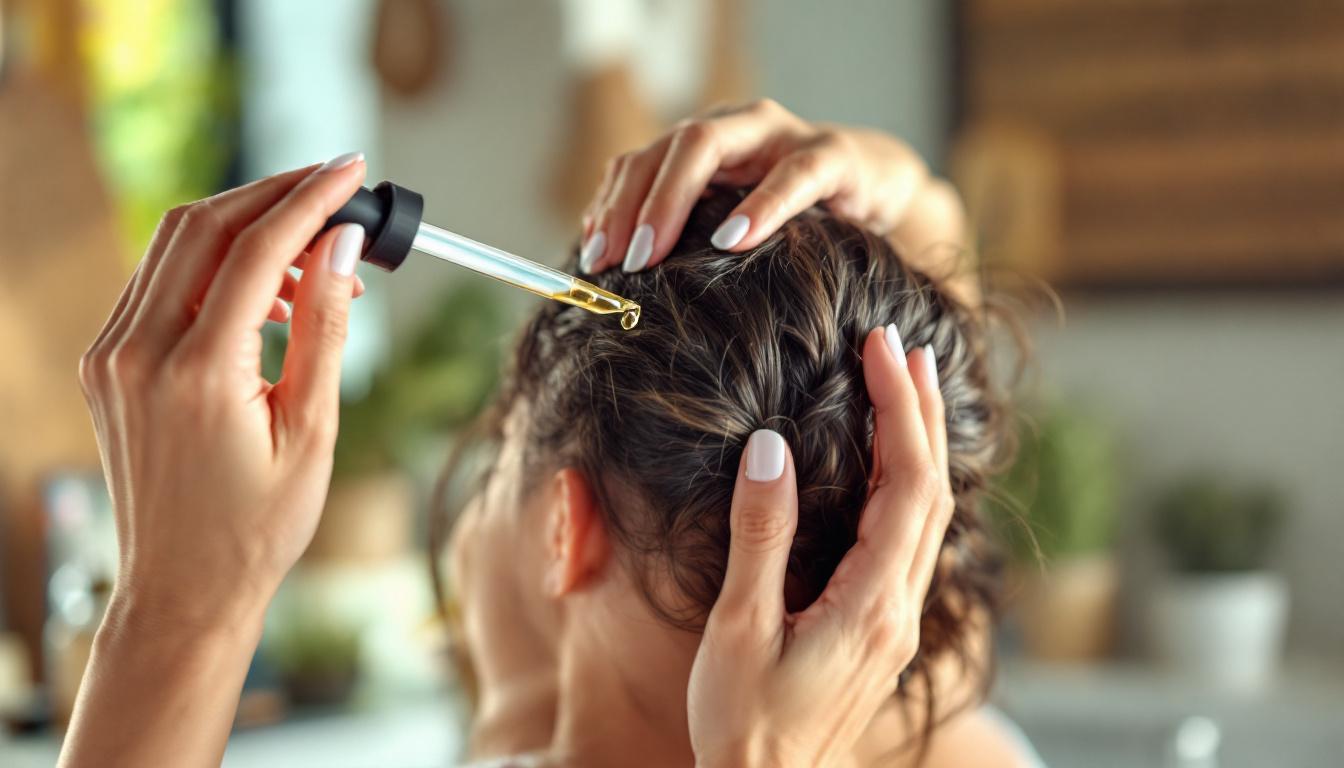
Application method: Massage the oil mixture into your scalp for 2 to 3 minutes using your fingertips. The massage itself helps with circulation. Focus on the areas where you’re experiencing thinning.
Leave-on time: Minimum 30 minutes. Overnight is fine if you put a towel on your pillow. Some people leave it on for a few hours and wash it out before bed.
Wash it out with your regular shampoo. You may need to shampoo twice to fully remove the oil.
Add 5 drops of rosemary oil to your shampoo bottle for a passive daily treatment. This is less potent than direct scalp application but requires zero extra effort and still delivers the active compounds.
Frequency: 2 to 3 times per week is the most common recommendation. The Panahi study used daily application, so if you want to match the study protocol, daily use is an option, but it requires more commitment.
The lazy method: Add 5 to 10 drops of rosemary essential oil to your shampoo bottle, shake well, and use it every time you wash your hair. This is less targeted than a scalp massage, and the oil has less contact time with your scalp, but it’s better than nothing and much easier to maintain as a habit.
What to Buy
The rosemary oil market is full of overpriced and misleading products. Here’s how to buy smart.
Look for 100% pure rosemary essential oil. The botanical name on the label should be Rosmarinus officinalis (some newer labels may list it as Salvia rosmarinus, which is the updated classification). The only ingredient should be rosemary oil.
Reputable brands that consistently deliver pure essential oils at fair prices: NOW Essential Oils, Plant Therapy, and Aura Cacia. All three are widely available online and in health food stores.
Apply rosemary oil to your scalp 2-3 times per week, leaving it on for at least 30 minutes before washing. Consistency over weeks and months matters far more than any single application, no matter how long you leave it.
Expect to pay $5 to $15 for a small bottle (10 to 30 ml). At 3 to 5 drops per use, a single bottle will last you months. This is one of the cheapest hair growth treatments you can try.
Avoid products labeled as “rosemary hair oil” or “rosemary growth oil.” These are typically bottles of carrier oil (sunflower, coconut, or mineral oil) with a tiny amount of rosemary mixed in. The rosemary concentration is usually too low to have any meaningful effect, and you’re paying a premium for what is essentially cooking oil with a nice smell. If you want a rosemary hair oil, make your own with the dilution ratios above. You’ll get a better product for a fraction of the price.
Storage matters. Essential oils degrade with exposure to light and heat. Buy bottles in dark glass (amber or cobalt blue), store in a cool place, and keep the cap tightly closed. A properly stored bottle of rosemary essential oil stays potent for 2 to 3 years.
Realistic Timeline
Hair grows slowly. About half an inch per month on average. No topical treatment changes that fundamental biology. What treatments can do is activate dormant follicles, extend the growth phase of the hair cycle, and make existing hairs thicker. All of that takes time.
Don’t expect to see anything before 3 months. The hair growth cycle has phases, and a follicle that’s been dormant needs time to re-enter the active growth phase (anagen), produce a new hair, and push it to a visible length.
The Panahi study measured results at 3 months and 6 months. At 3 months, there were early signs of improvement. At 6 months, the results were significant. This tracks with what most people report online: noticeable changes somewhere in the 4 to 6 month range.
Consistency is everything. Applying rosemary oil once a week for two months and concluding it doesn’t work is not a fair test. You need to commit to regular application for at least six months before you can evaluate results.
Take photos. Your brain is terrible at detecting gradual change. Take a photo of your hairline or thinning area on day one, under consistent lighting, and retake it monthly from the same angle. Photos don’t lie. The mirror does.
If you don’t see improvement after six months of consistent use, it’s probably not going to work for your specific situation. That’s not a failure. Not every treatment works for every person. It means you have useful information and can explore other options.
Safety and Side Effects
Rosemary oil is generally safe when used properly, but “natural” doesn’t mean “harmless.” A few precautions.
Do a patch test first. Mix a small amount of diluted rosemary oil and apply it to the inside of your wrist. Wait 24 hours. If there’s no redness, itching, or swelling, you’re likely fine to use it on your scalp.
Common side effects: Mild scalp irritation and itching, particularly in the first few weeks. This usually subsides as your skin adjusts. If it persists or worsens, reduce the concentration (fewer drops per tablespoon of carrier oil) or stop using it.
Allergic reactions are rare but possible. Signs include significant redness, swelling, hives, or difficulty breathing. If you experience any of these, wash the oil off immediately and seek medical attention.
Pregnancy and breastfeeding. Rosemary oil has not been adequately studied in pregnant or breastfeeding women. Most dermatologists and obstetricians recommend avoiding essential oils during pregnancy as a precaution. Talk to your doctor.
Blood thinner interactions. In large amounts, rosemary has been reported to have anticoagulant effects. This is more of a concern with ingestion than topical use, but if you’re on blood thinners (warfarin, heparin, or similar medications), mention your rosemary oil use to your doctor.
Never ingest essential oils. This should go without saying, but the internet is full of bad advice. Rosemary essential oil is for external use only. Swallowing it can cause vomiting, kidney damage, and seizures.
Rosemary Oil vs. Minoxidil
This is the comparison everyone wants to make, so let’s be direct about it.
Minoxidil has decades of clinical evidence behind it. It’s FDA-approved for the treatment of androgenetic alopecia. It’s been tested in numerous large-scale trials. It’s available over the counter. We know its efficacy rates, its side effect profile, and its long-term outcomes.
Rosemary oil has one clinical trial. One good trial, but one trial. The evidence base is not comparable.
If your hair loss is significant and progressing, minoxidil (especially the 5% formulation) is the stronger evidence-based choice. Pairing it with the right shampoo for thinning hair can further support your scalp environment. You’re betting on a treatment with a long, well-documented track record.
If you want to try a natural option first, rosemary oil is the most evidence-backed choice in that category. Nothing else in the “natural hair growth” space has a head-to-head clinical trial against minoxidil. That counts for something.
You can use both. Rosemary oil and minoxidil are not mutually exclusive. Some people apply minoxidil in the morning and rosemary oil at night. There’s no published research on this combination specifically, but there’s no known contraindication either.
Cost comparison: Minoxidil runs $15 to $50 per month depending on the brand and formulation. Rosemary oil costs $5 to $15 for a bottle that lasts 2 to 3 months. If budget is a factor, rosemary wins easily.
Side effects comparison: Both can cause scalp irritation. Minoxidil can also cause unwanted facial hair growth (particularly in women), dizziness, and rapid heartbeat in rare cases. Rosemary oil’s side effect profile appears milder, though it’s been studied far less.
The bottom line: if you want certainty, go with minoxidil. If you want to try a lower-cost, lower-risk option first and you’re patient enough to give it six months, rosemary oil is a reasonable choice. Just go in with realistic expectations.
Key Takeaways
- One clinical trial (Panahi et al., 2015) found rosemary oil comparable to 2% minoxidil for androgenetic alopecia over 6 months
- The evidence is promising but limited to a single small study of 100 participants
- Always dilute rosemary essential oil in a carrier oil before applying to your scalp
- Expect to wait 3 to 6 months of consistent use before seeing results
- Rosemary oil is not a replacement for medical advice if you’re experiencing significant hair loss
Frequently Asked Questions
One clinical trial showed it increased hair count in people with androgenetic alopecia over six months. That’s the strongest evidence we have. It may help stimulate growth in dormant follicles, but it’s unlikely to regrow hair in areas where follicles have been permanently lost. If you’ve been bald in an area for years, no topical treatment (including minoxidil) will bring those follicles back.
Most people who report results see changes between 4 and 6 months of consistent use. The Panahi study measured significant improvement at 6 months. Don’t expect overnight results. Hair biology doesn’t work that way.
Yes, as long as it’s properly diluted in a carrier oil. Put a towel on your pillow to protect it from oil stains. Some people find overnight application more convenient and believe the extended contact time helps, though there’s no study comparing leave-on times.
Not based on current evidence. One study found them comparable, but minoxidil has been validated in dozens of large-scale clinical trials and is FDA-approved. Rosemary oil may be a reasonable first option if you prefer a natural approach, but minoxidil has a much stronger evidence base. They can also be used together.
No credible evidence suggests rosemary oil causes hair loss when used at proper dilutions. However, undiluted essential oil can irritate or damage the scalp, which could theoretically worsen hair health. Always dilute, always patch test, and stop using it if you notice increased shedding or irritation.
Sources & References
- Panahi, Y., Taghizadeh, M., Marzony, E.T., & Sahebkar, A. “Rosemary oil vs minoxidil 2% for the treatment of androgenetic alopecia: a randomized comparative trial.” SKINmed, 13(1), 2015, pp. 15-21.
- Murata, K., Noguchi, K., Kondo, M., Onishi, M., Watanabe, N., Okamura, K., & Matsuda, H. “Promotion of hair growth by Rosmarinus officinalis leaf extract.” Phytotherapy Research, 27(2), 2013, pp. 212-217.
- Begum, A., Sandhya, S., Shaffath Ali, S., Vinod, K.R., Reddy, S., & Banji, D. “An in-depth review on the medicinal flora Rosmarinus officinalis (Lamiaceae).” Acta Scientiarum Polonorum Technologia Alimentaria, 12(1), 2013, pp. 61-73.
- American Academy of Dermatology. “Hair loss: Diagnosis and treatment.” aad.org.
Try different hairstyles on yourself
Upload your photo and see how any hairstyle looks on you before committing.
Try HairStyleMojo Free